
Authenticity Is the New Luxury. So Why Are We Being Sold Fakes?
Authenticity is what every 2026 travel trend report agrees people want most, and Naoussa’s napkin party isn’t the only thing being sold as it. From overbuilt resorts to reinvented menus, Greece is manufacturing ‘authentic’ fast. Here’s how to tell what’s real.
One word keeps appearing in every travel forecast this year: ‘authenticity’. It’s what travellers say they want most, and what they’re willing to pay extra for. Unfortunately, some people will always try to exploit and capitalise on this kind of demand quickly. On Paros, manufacturing has already made its mark, complete with a soundtrack and a napkin waiting for you at your table. But that’s not all: you can also find it in the resorts popping up around the island and on the menus overcharging for a dressed-up Greek salad.
Every current travel trend report lands on some version of the same message, stating that authenticity is the new luxury. ‘Whycation’ is the term used to describe the trend of starting a trip with a purpose rather than a destination, as outlined in Hilton’s 2026 trends report. Similarly, Booking.com highlights that travellers are now opting for journeys that “reflect their quirks, goals, and passions” rather than one-size-fits-all itineraries.
This demand did not appear out of nowhere. Spain has seen large-scale anti-tourist protests in recent summers, Japan cancelled a cherry blossom festival due to visitors misbehaving, and destinations worldwide are now dealing with overcrowding, rental price hikes and environmental impact promptly rather than after the fact. As Tim Oakes, the managing director of the B-Corp tour operator Inside Travel Group, told the BBC: “Overtourism is one of the biggest threats facing the future of travel”. He made a distinction worth bearing in mind: “These are places that actively want visitors, just not overcrowding”.
In response, destinations are rethinking what they are actually selling. A growing number of destinations are adopting an experience-led model designed to spread visitors out: fewer iconic sites, more neighbourhoods, food, and local culture. Those three photos no longer tell the story. This is not just a marketing tweak, say industry analysts. They see it as a structural shift towards what one recent report calls “a more resilient tourism ecosystem built around authenticity, community value, and sustained visitor engagement”. For once, both travellers and destinations are pulling in the same direction.
In fact, what travellers are looking for has also started to change. Traditionally, personalisation was based on a profile created from previous bookings. Now, however, it is becoming more conversational and adaptive. This means it will respond to a traveller’s mood, delays or companions during the journey, rather than offering a one-off recommendation at the time of booking. Surprisingly, all this flexibility is also creating a demand for the opposite: faced with endless options, people are increasingly looking for a few well-matched choices rather than another long list of similar ones. People no longer judge a trip by how many attractions they ticked off, which is great news. They judge it by how it makes them feel: calmer, more connected, more like themselves.
If you ask people what makes a trip feel meaningful, the answer is straightforward. In a 2025 Instagram poll conducted for The Tiny Tourist Report, 49 per cent of respondents cited everyday local experiences as the most meaningful aspect of a trip, while only 4 per cent cited must-see sights. The same report refers to this as ‘trusting the boring’: supermarket aisles, petrol station snacks and everyday objects are all capable of holding as much weight as landmarks once you actually look at them properly. This prioritises the grocery store over the postcard, and it also aligns with the findings of larger industry reports.
Authenticity is expensive to fake. Someone fakes it anyway.
Wanting something real does not make it easy to find. A market that suddenly values authenticity creates an obvious opportunity for whoever can produce the most convincing imitation of it the fastest.
What that looks like in practice is less about finding somewhere undiscovered and more about looking differently at what is already there: the corner shop instead of the landmark or a conversation that actually gets remembered. It rewards time spent talking to people, whether you already know them or not, over anything an algorithm can hand you. It also relies on local knowledge rather than another vlog or TikTok since, in such an overloaded space, that’s the one thing left that still stands out.
That opening has already consumed one entire channel. Sam Blenkinsopp, co-founder of the travel recommendation platform Trippin, has witnessed what he calls “the promise of authenticity” born from creator-led travel content collapse “into an oversaturated sea of midness that has flattened taste globally”. A white napkin party in Naoussa is not responsible for that cultural blandness. It is just one small, everyday example of the same phenomenon: anything that can be labelled ‘real’, filmed once then copied everywhere.
Greece has been here before, more than once. What has changed is not that someone is manufacturing tradition. Greek tourism has done that for over sixty years. What is new is how quickly this takes place nowadays, and the effect this has on the distinction between a real custom and a performance of one.
What a made-up tradition looks like.
If you walk into Naoussa’s small fishing harbour on a busy summer night, at some point the music changes without warning and the whole place will stand up. You become witness to a white napkin party where a hundred or more people will wave their napkins overhead together and dance on chairs and tabletops to the music of ABBA.
None of that would be worth writing about, given that venues have always found ways to get people moving. Except that, nowadays, it is being sold loudly and deliberately as heritage. A travel account’s caption puts it plainly: “In Paros, dinner isn’t just about food, it’s about the unforgettable experience of standing on tables and waving white napkins with everyone else”, filed under the label “the epic tradition of napkin waving”. Search the term and you will find it spreading beyond Paros. ‘White Napkin Party’ is now its own hashtag, a custom that has been exported to other islands without anyone asking where it actually came from.
So draw your own conclusion: the napkins are already on the tables before the music starts, at two separate venues at least. And you can see this for yourself, Reel after Reel. The setup speaks for itself: it is reasonable to assume that it is done deliberately to guarantee social media coverage.
Know that there really is a handkerchief used in Greek dancing. In the Kalamatianos and the Tsamiko, the two line dances you will regularly see at village panigiris, the lead dancer holds the next dancer by a handkerchief instead of by the hand. This is a practical choice: by not holding hands, the lead dancer can perform faster, more acrobatic steps while the rest of the line stays connected. Some accounts trace this practice back to descriptions of dancing in ancient Sparta. A room full of tourists standing on furniture waving cloth napkins to a Swedish pop song borrows exactly one detail from it, the handkerchief, and none of the rest.
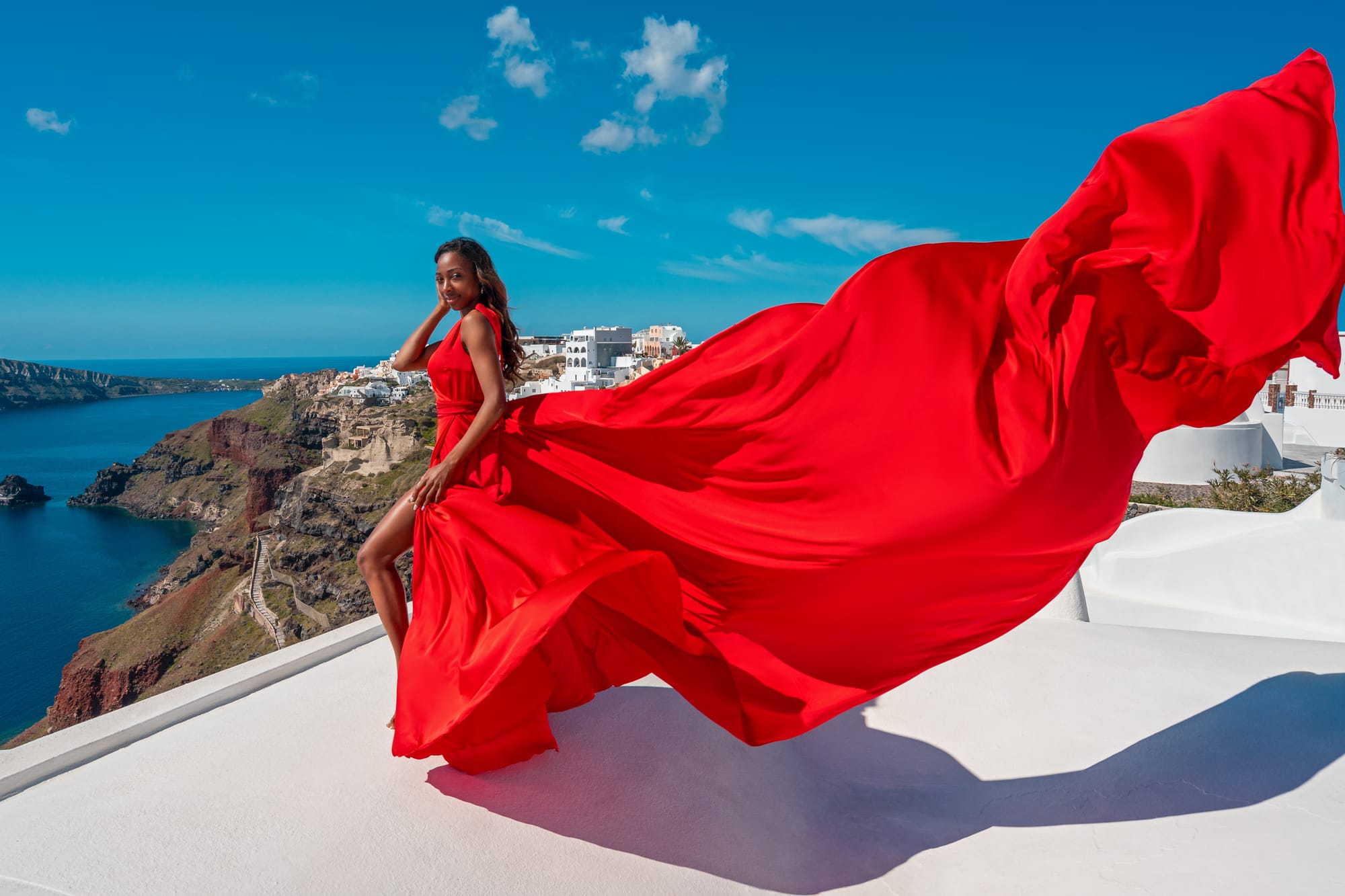
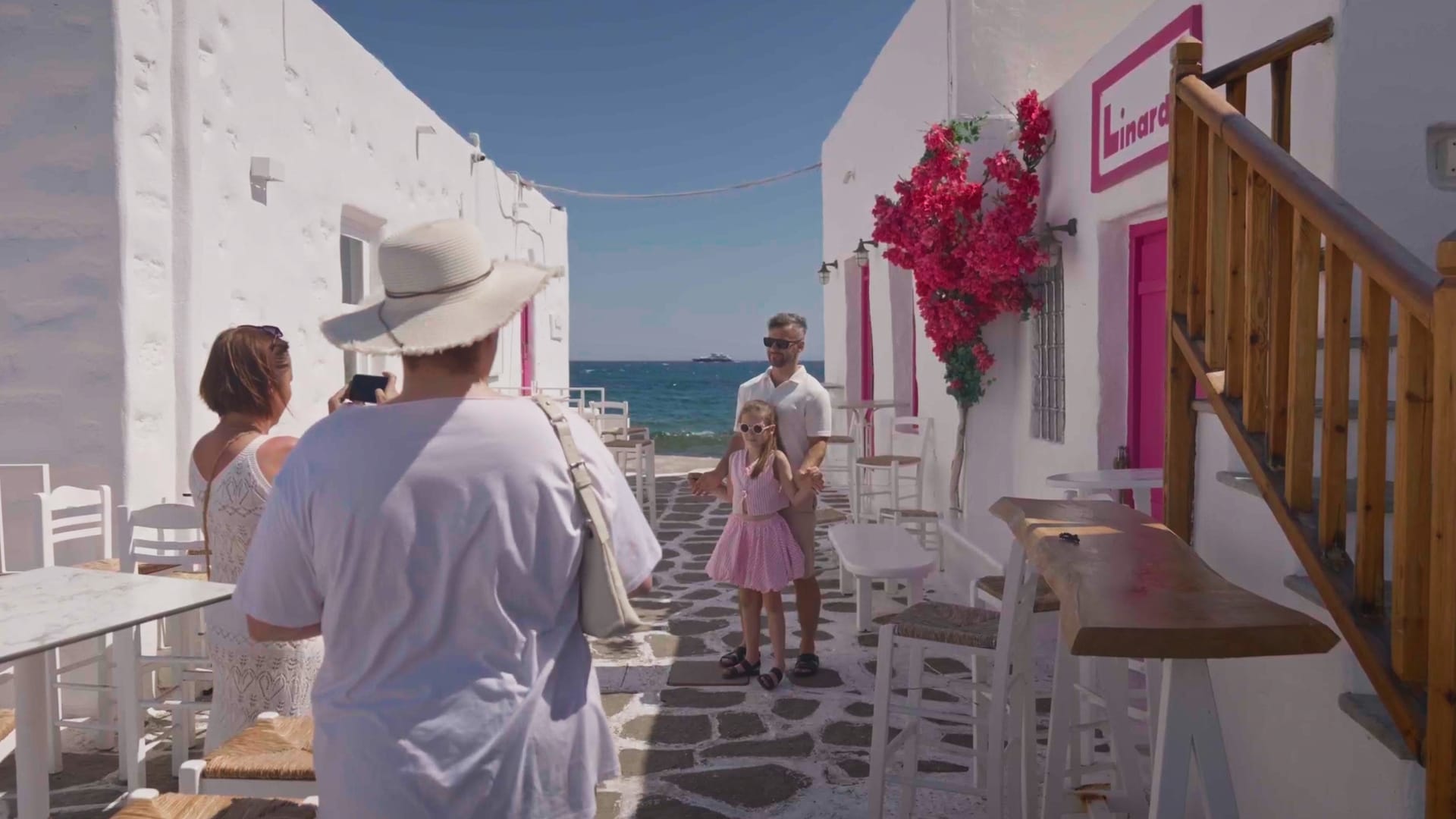
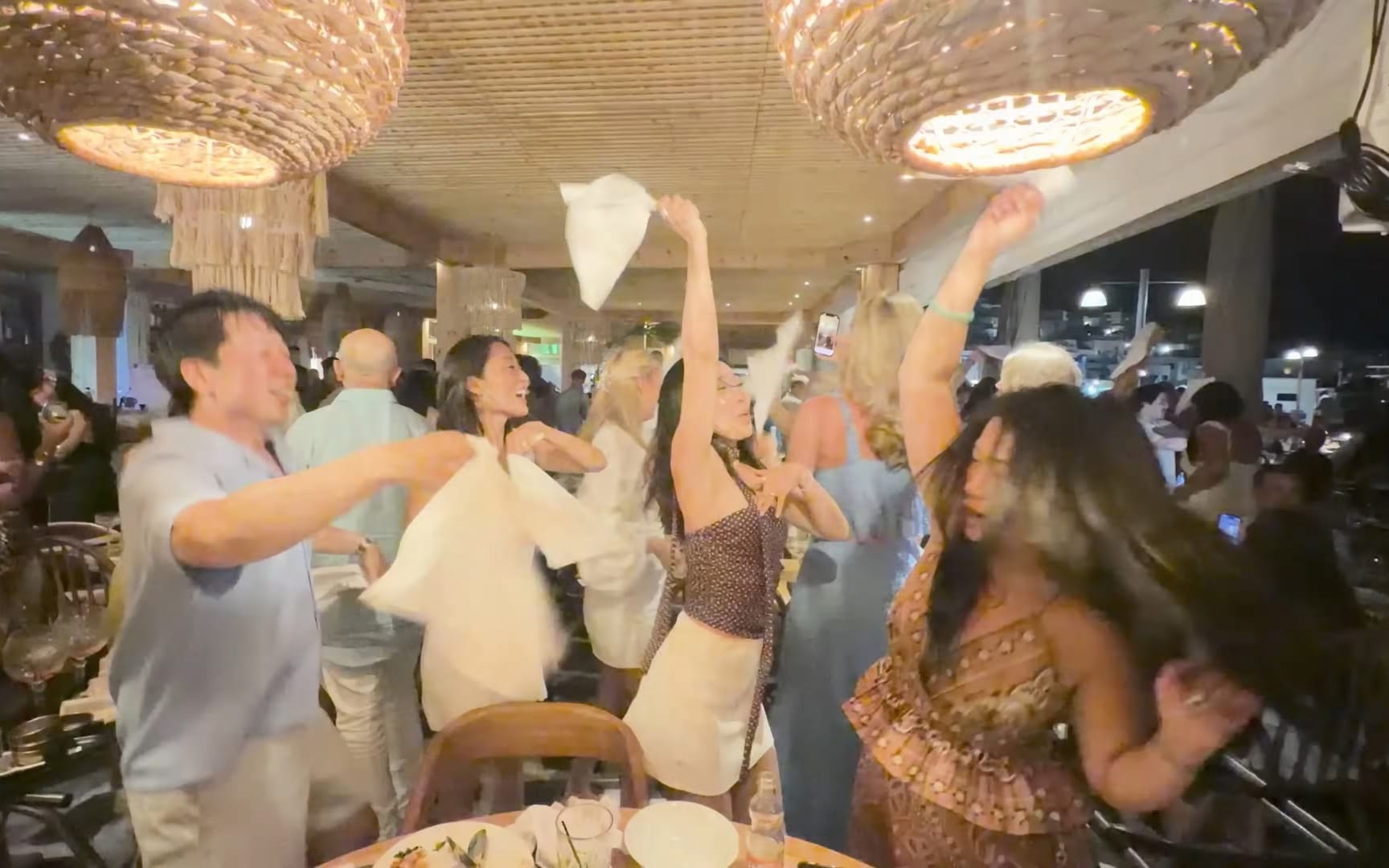
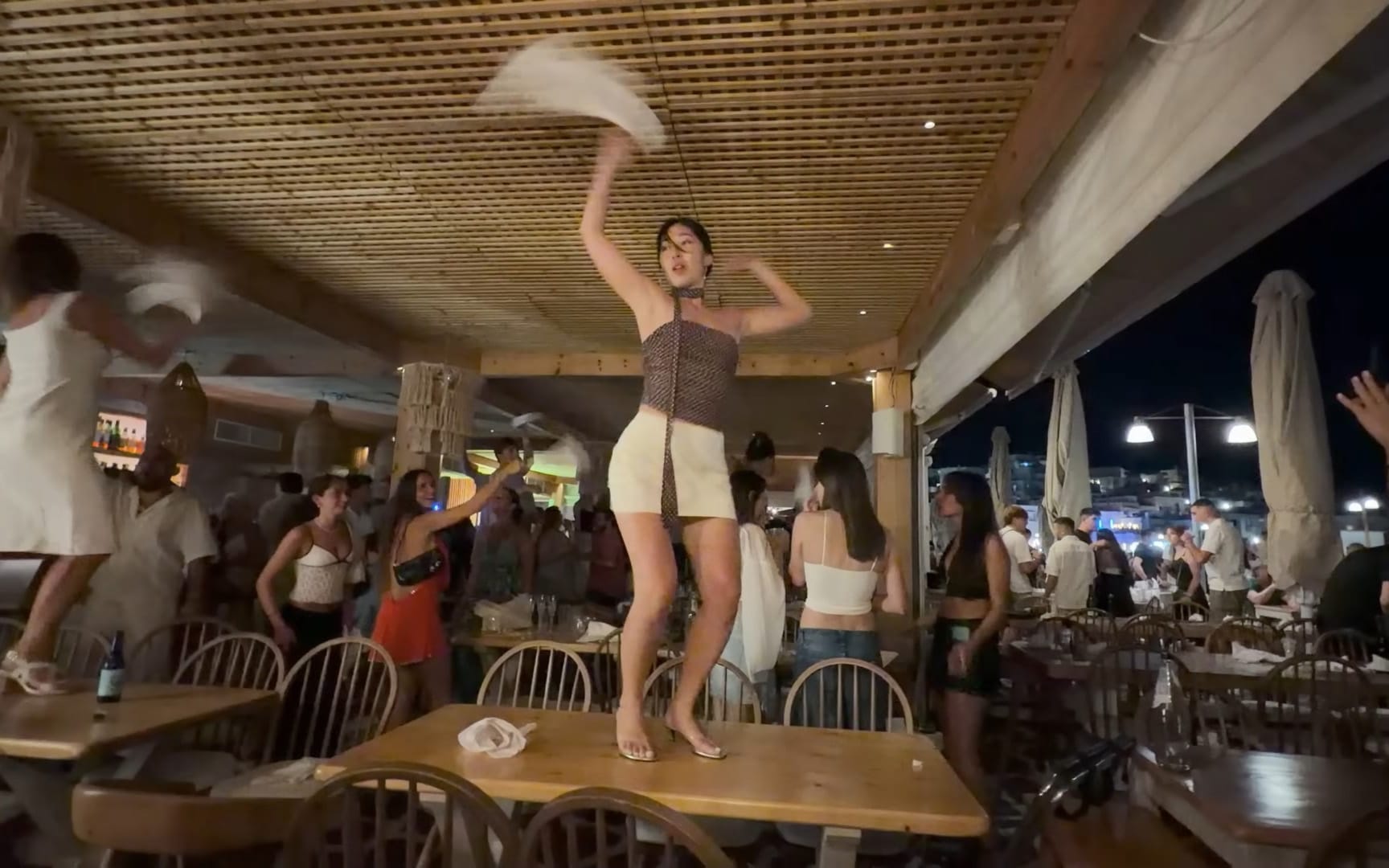
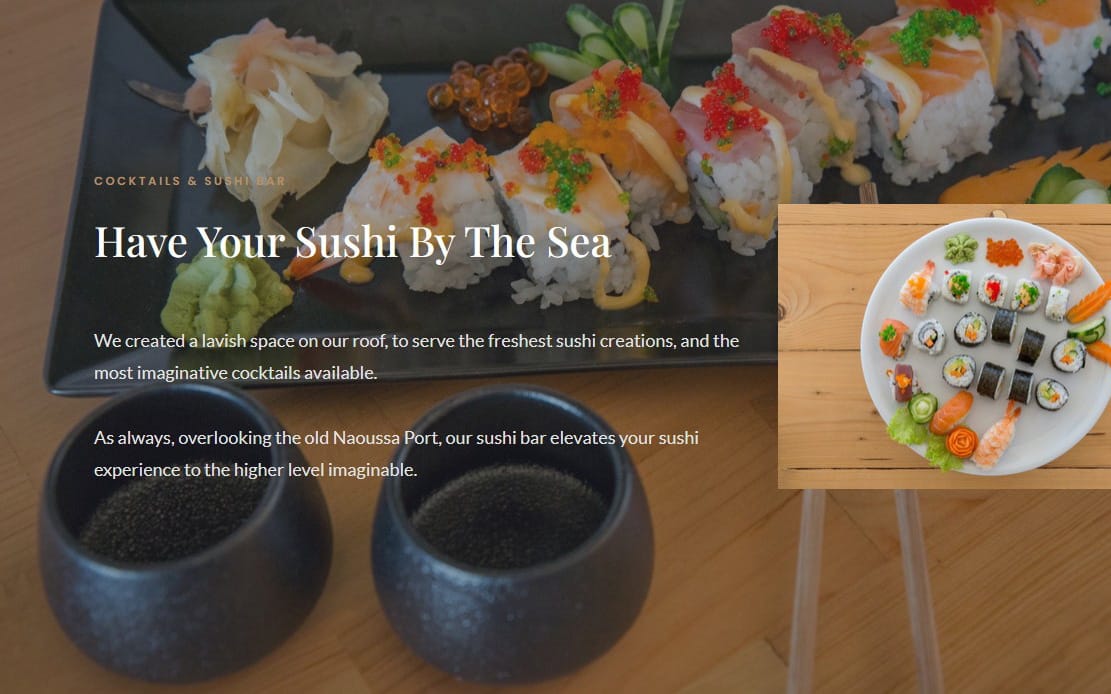
Manufactured spectacle, four ways: a flying-dress shoot, the postcard alley where the bougainvillea are actually plastic (most tourists queuing for the photo never notice), the napkin party in motion, and a restaurant's own marketing for its sushi.
Santorini’s flying dress photoshoot doesn’t even bother with borrowing. A model or tourist puts on a long, flowing dress and an assistant fans the fabric with a leaf blower against the island’s white and blue backdrop. The photographer then sells the print, which is a real business and not a cultural echo of anything. Founded in 2016, the Santorini venue now runs at around 550 euros per person per hour, sometimes running eight sessions a day. The concept has since been exported unchanged to Dubai and beyond, which proves that it was never specifically about Santorini. It’s essentially just a photo shoot with an island as the backdrop.
It doesn’t stop at the napkins.
This same logic is not limited to dinner tricks. Paros is in the middle of a construction boom, with the number of five-star properties on the island more than doubling from six in 2019 to fifteen by 2025. Apparently, if you call enough of what you are building ‘luxury’, enough of the market will believe you.
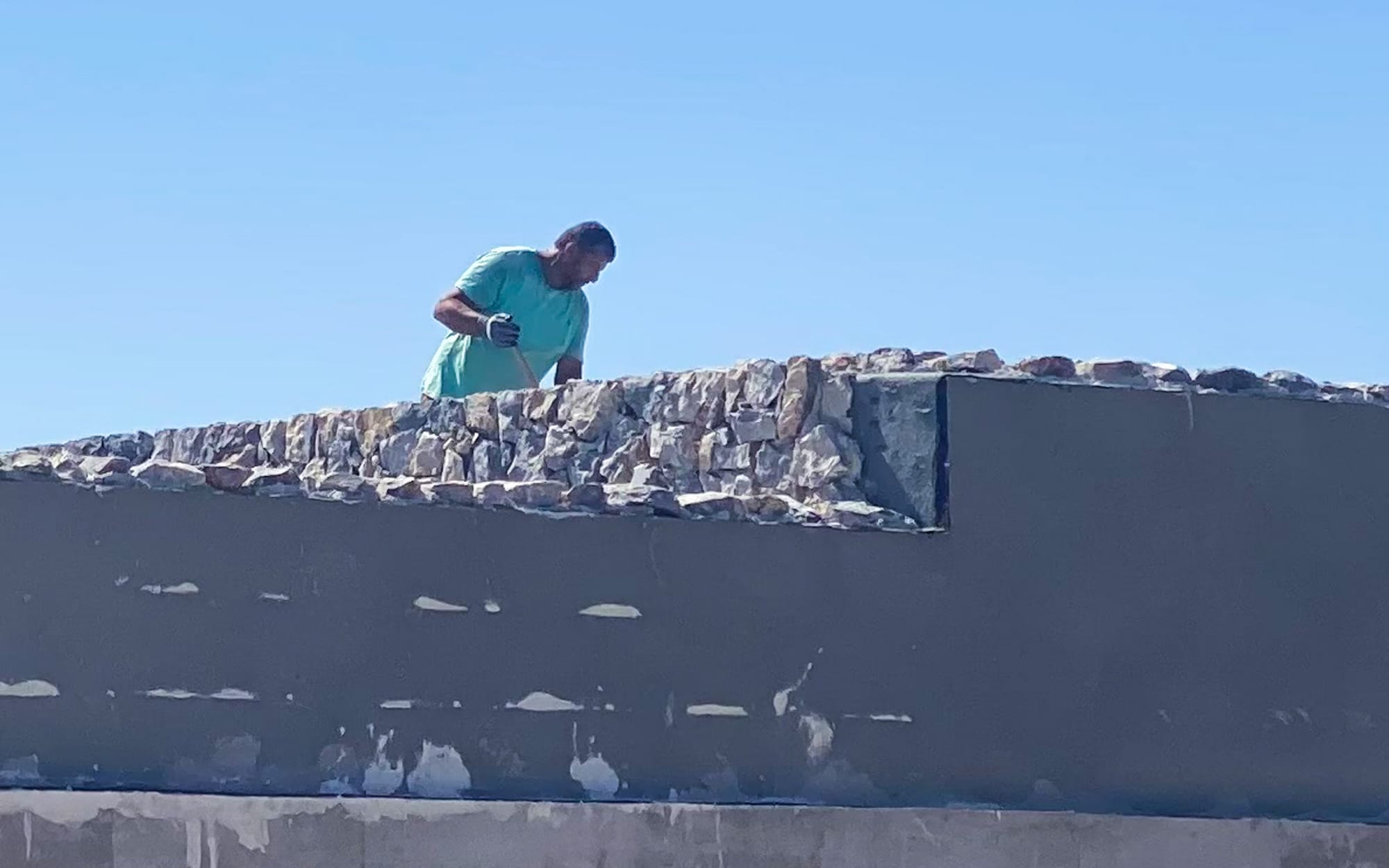
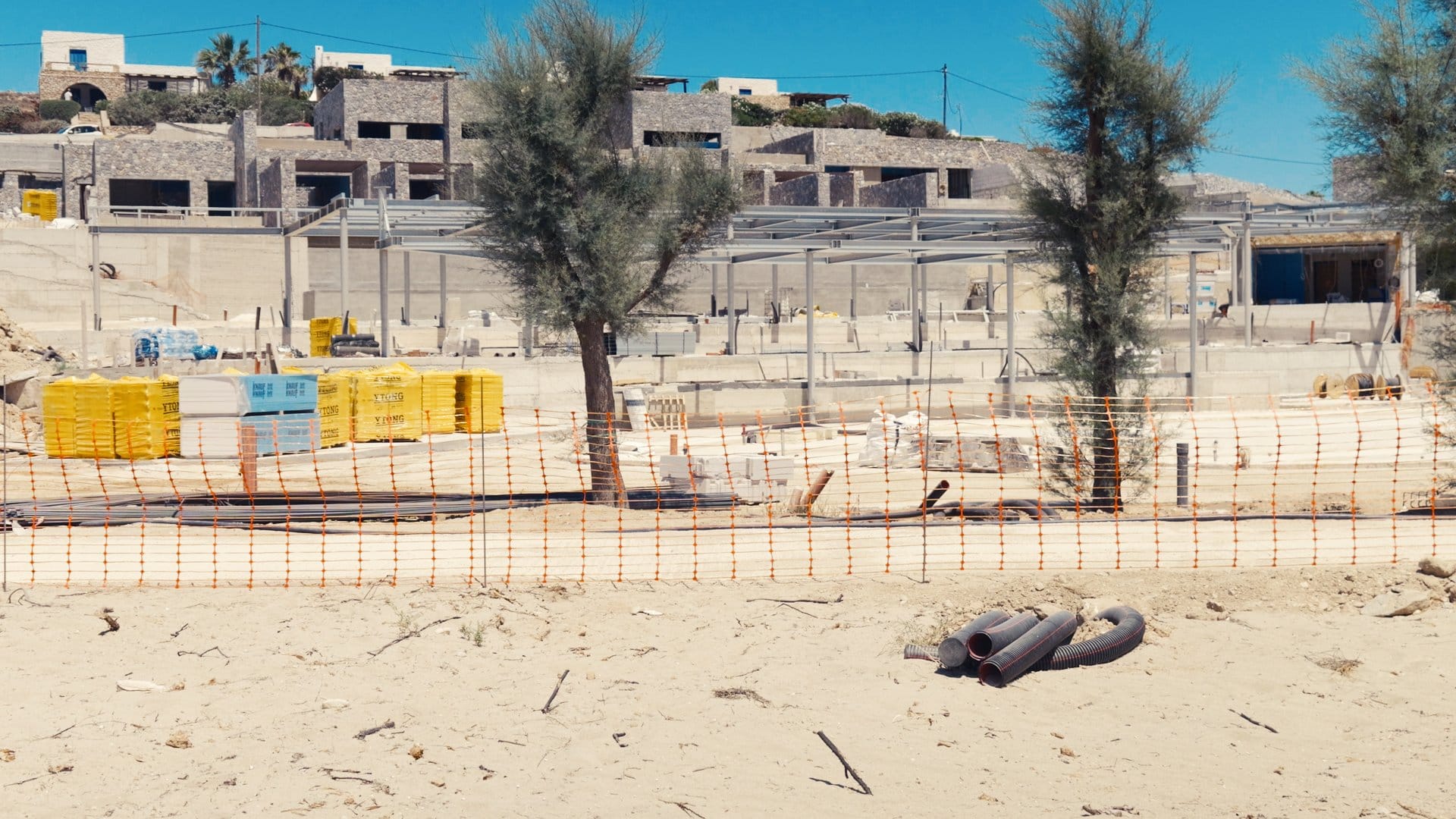
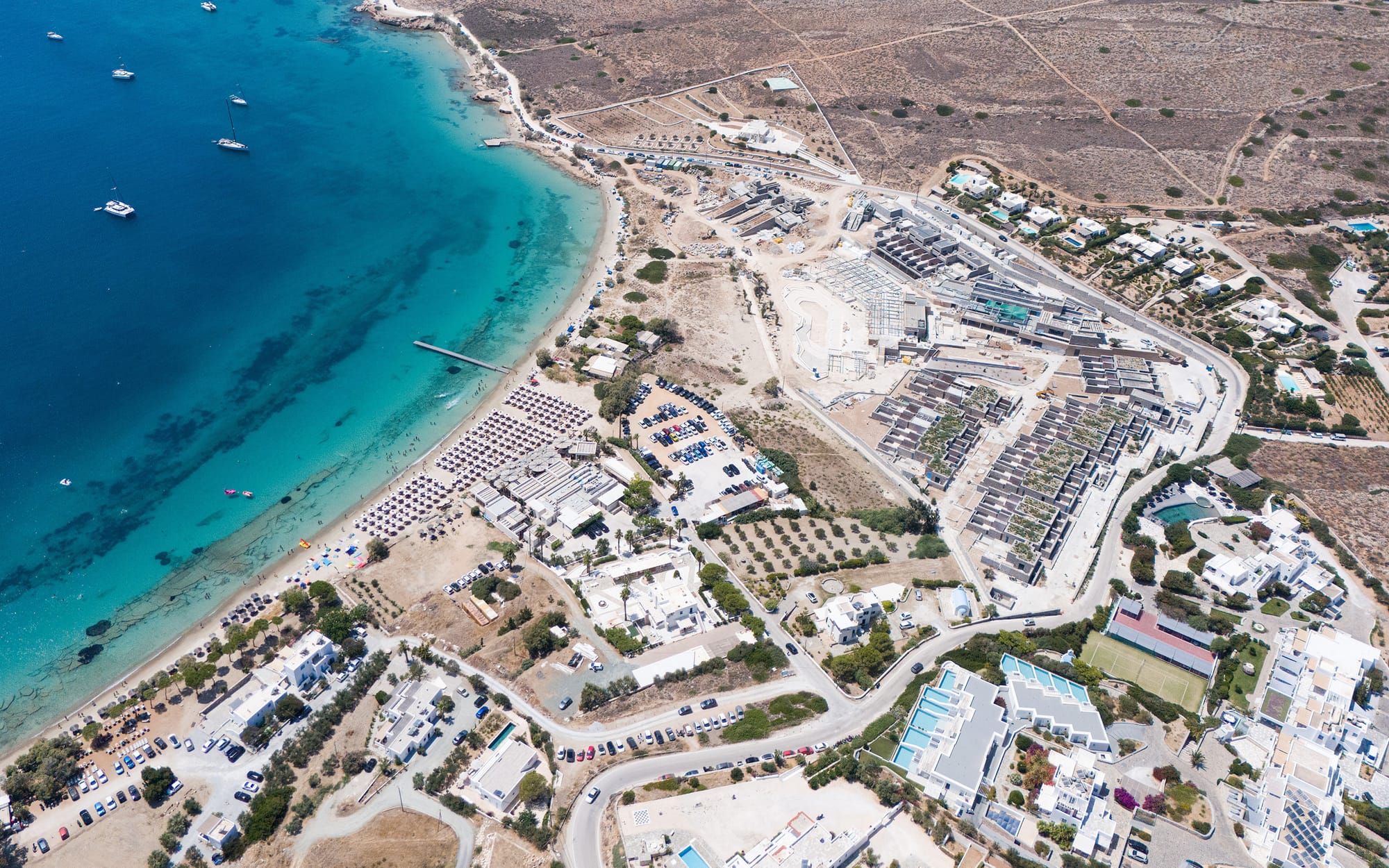
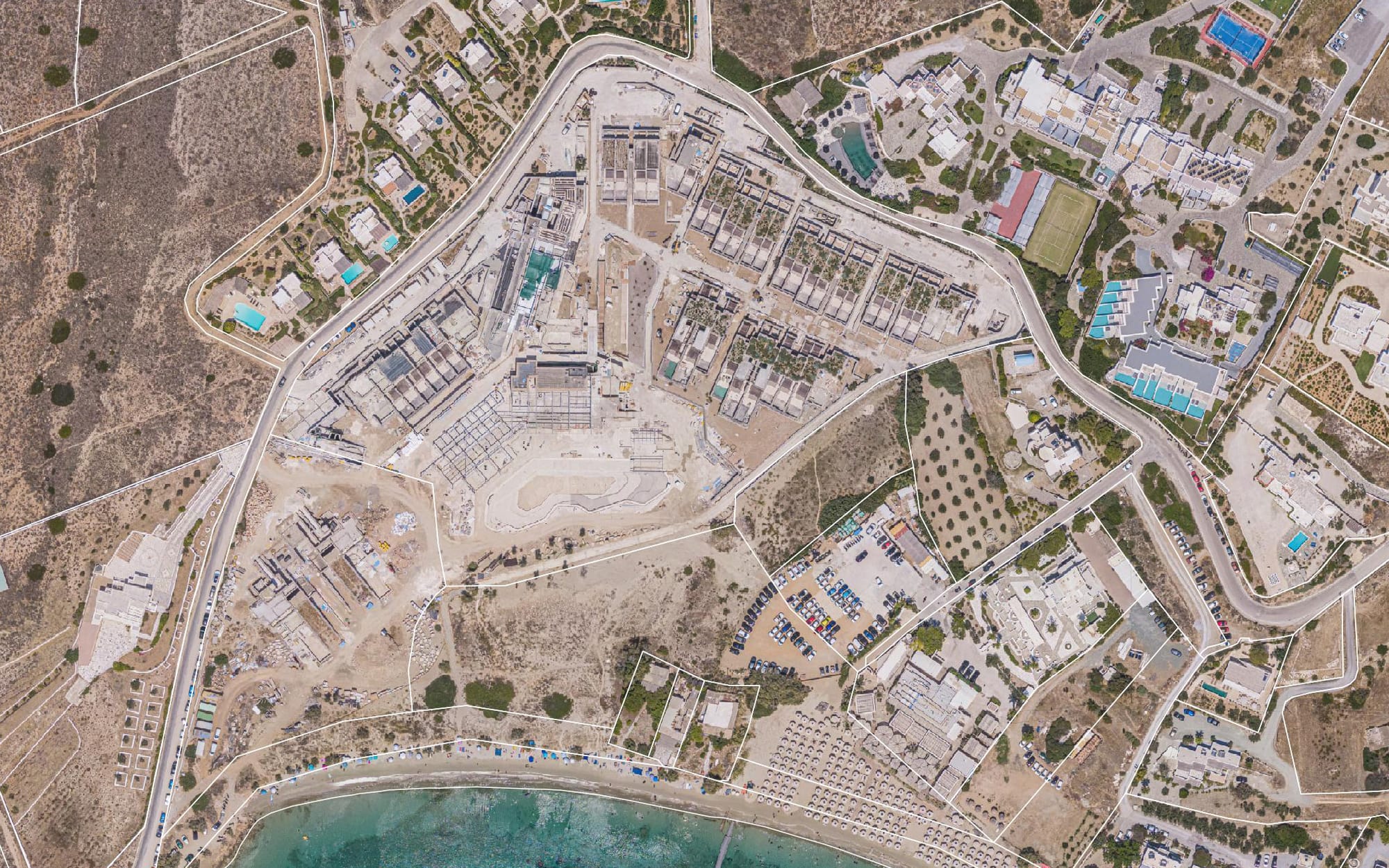
Kensho Paros under construction near Marcello beach: stone slabs going up over bare concrete, and the finished footprint from above, row after row of units and pools.
Kensho Paros, the new five-star development near Marcello beach in Parikia, is an example of what this boom actually looks like up close. The units look barely bigger than shipping containers from the outside, built in a tight row. Each one has a small private pool at the front, and it does most of the marketing work: remove it and the development reads less as private, sea-facing luxury and more as a terraced housing estate with better renderings.
Take a look at how it’s actually being built, and the term ‘manufacturing’ takes on a whole new meaning. Photos taken during construction show workers fitting individual stone slabs onto the parapet of an otherwise bare concrete structure. It’s more like cladding than building: a cosmetic layer of stone is glued onto a poured concrete box, but the stone isn’t actually doing any real structural work. From the right angle, it photographs like a traditional Cycladic building. But it is not built like one.
This is not just one outside opinion. The Parikia Traditional Settlement Association has described it as a symbol of the changes occurring on the island. Residents have expressed real concerns about the pools’ impact on the water supply, given the island’s limited resources. A group of residents filed a legal appeal against the building permit in late 2025, and a court decision is not expected until October 2027. Whatever the court eventually rules, the rooms will likely be finished and rented out years before a decision is made on whether the development should have been approved.
Compare that to how Cycladic houses actually got built. The stone was structural: thick, load-bearing walls doing the work of holding the building up, not a decorative skin. The whitewash was not a style choice either, it was a lime coating reapplied yearly to protect the walls from moisture, insects and plant growth. Roofs were local timber and reed, layered with seaweed for insulation, whatever the island actually had available. None of it was quick to build, and none of it was designed to be replicated identically.
Food is following a similar script. A sushi bar on the beach here, a taverna charging city prices for a dressed-up Greek salad there, none of that is wrong on its own. Tourists are allowed to want variety, and nobody is obliged to eat only what previous generations ate. The risk is not that these things are offered. It is that they start to get sold as an authentic Paros experience, rather than what they actually are: options, available at a price, with nothing particular to do with the place.
None of this is about napkins, pools, or sushi but about who gets to decide what counts as the real version of a place. And that comes down to whether that decision sits with the people who have lived here for generations or with whoever can afford to build, plate up, or hype something fast enough to sell it back to the visitors.
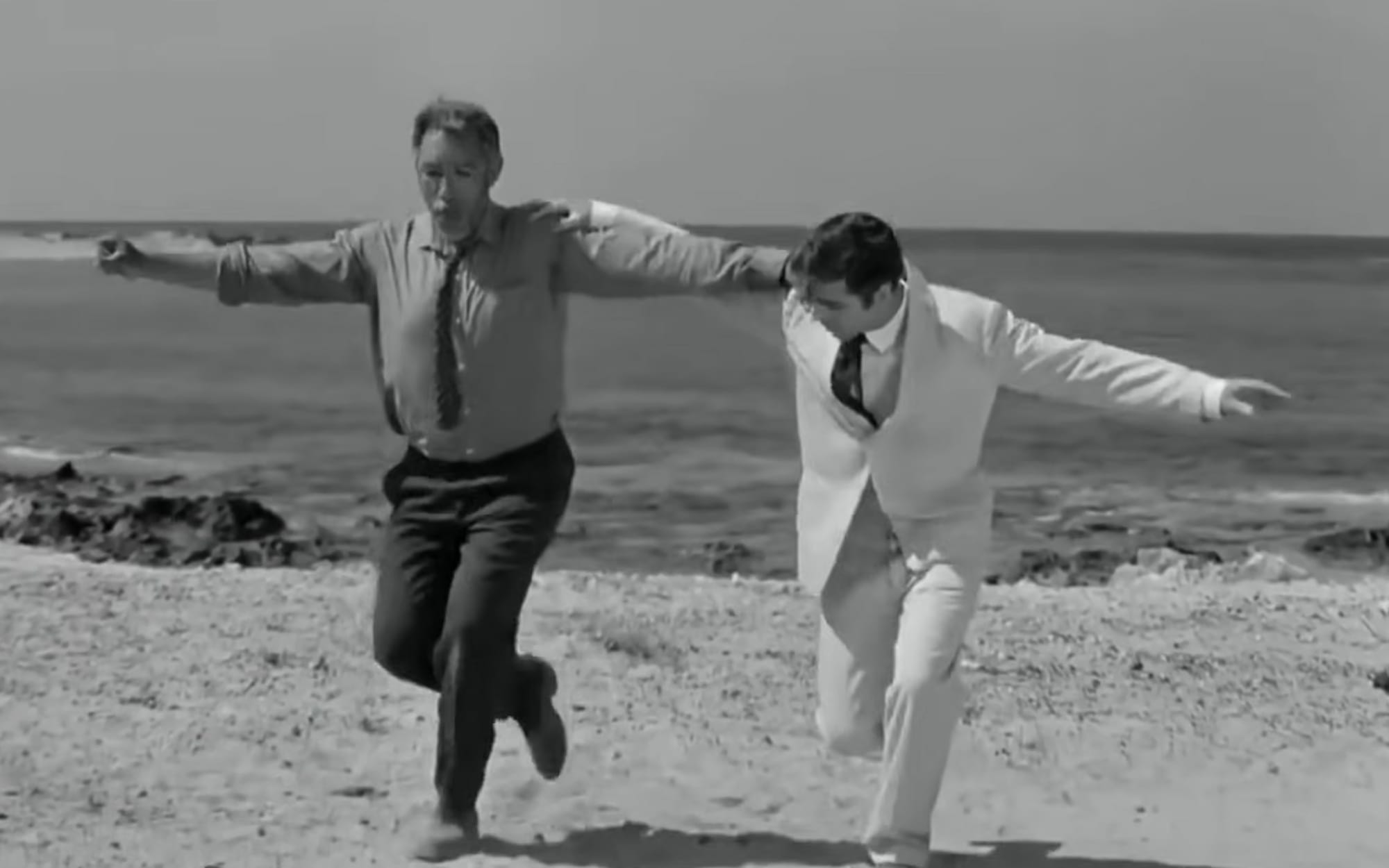
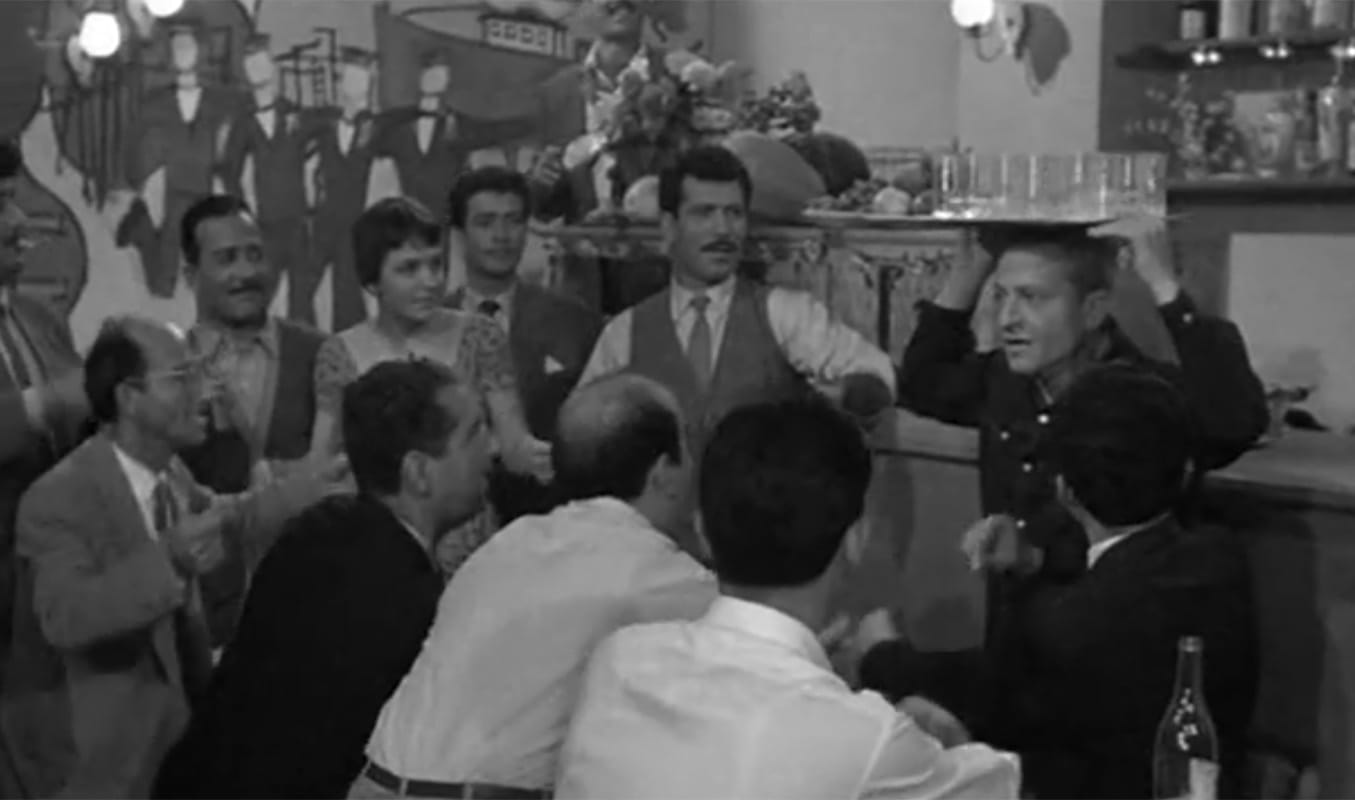
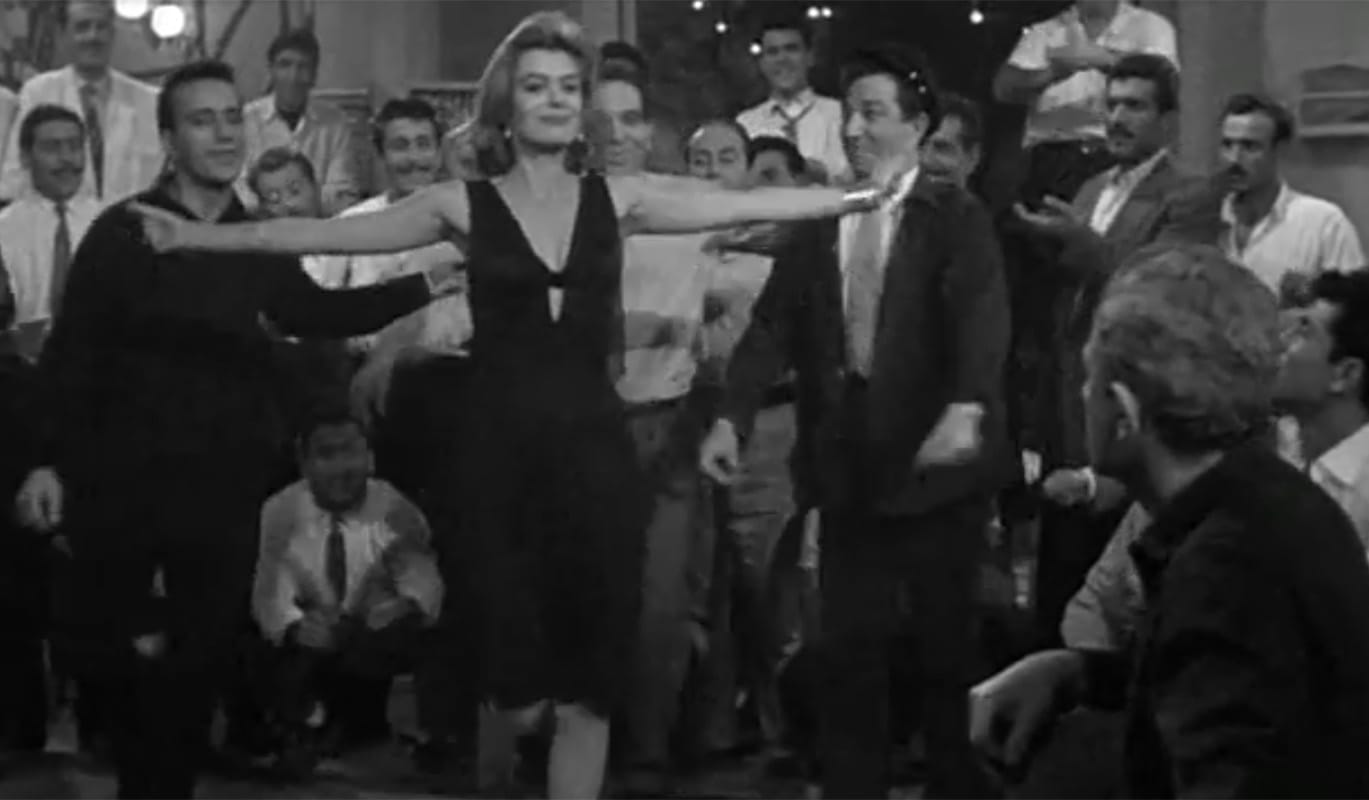
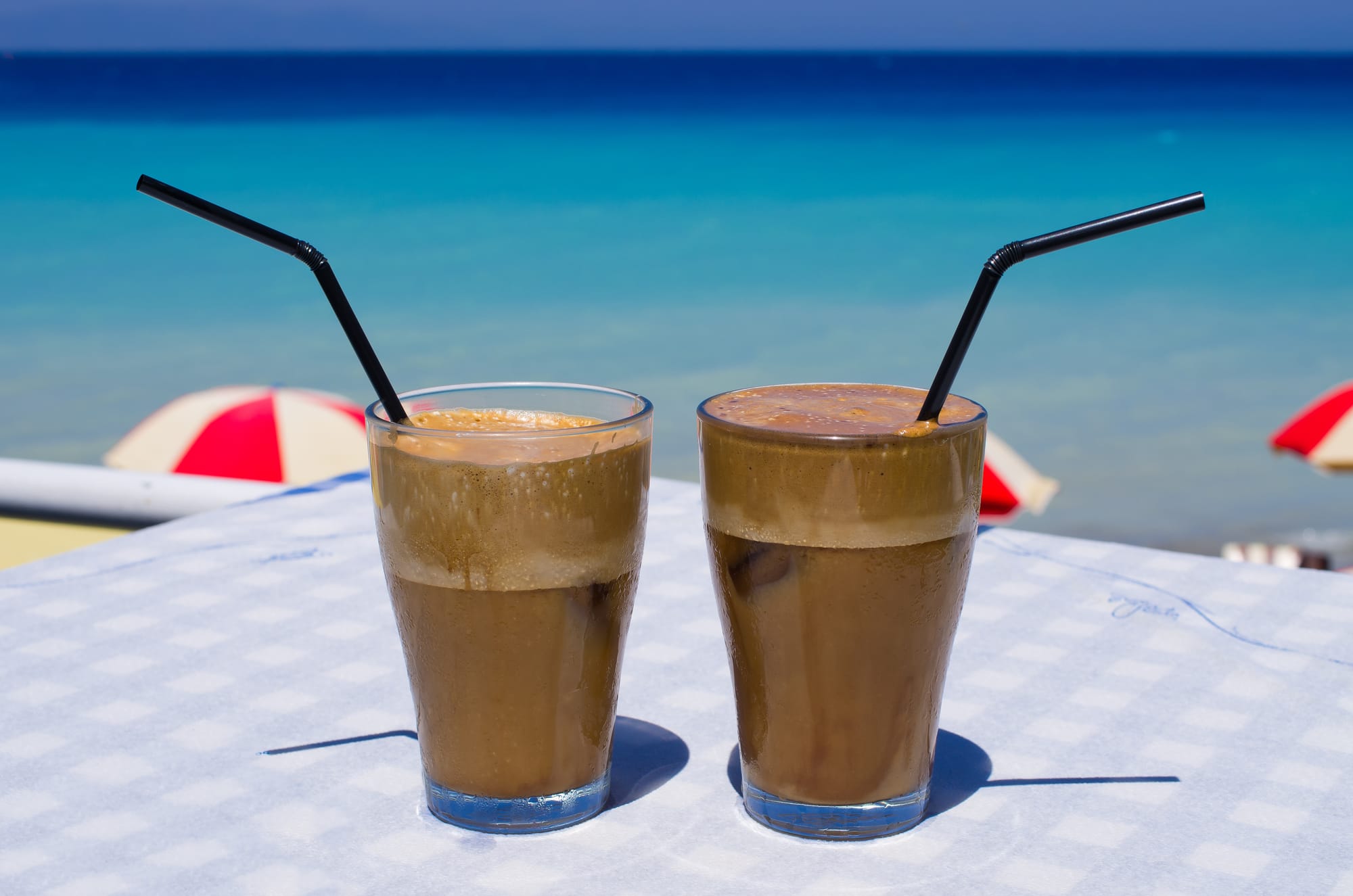
Where three 'Greek' traditions actually started: Anthony Quinn dancing the Sirtaki in Zorba the Greek (1964), scenes from the plate-smashing film Never on Sunday (1960), and the frappé, a 1957 improvisation with instant coffee.
Greece has manufactured tradition before. Just slower.
Begin with the dance that most people would confidently call the most Greek thing there is: the Sirtaki. Contrary to popular belief, it does not originate from a village square. It was created for a film set. Giorgos Provias created the choreography for the 1964 film Zorba the Greek, with music written by Theodorakis for the same production. According to the most widely accepted version of its origin story, Anthony Quinn, playing Zorba, was unable to perform the faster steps he had been taught due to an injured foot. So, the choreography was adapted on the spot to include the slower, dragging steps that are now world-famous. The dance wasn’t even named until the film’s premiere.
It is not something that has been invented out of thin air. In fact, it is a combination of real material, including dragging Syrtos, slower Hasapiko and faster Hasaposerviko, which have been put together in a new sequence that has been built for a cinema audience. Scholars often cite it as a textbook example of an invented tradition. And yet, sixty years on, the Sirtaki has become a genuine and integral part of Greek life. Nobody dances it ironically anymore.
The practice of smashing plates took a different route from a similar starting point. There is no documented historical tradition behind it. Its popularity can be traced specifically to a plate-breaking scene in the 1960 film Never on Sunday. Nevertheless, it quickly became big business: by the 1960s, Greece was smashing up to 100,000 plates a month for tourists, supporting more than fifty workshops and around a thousand workers. Unlike the Sirtaki, it never really took off. Most Greeks themselves now treat it as a tourist cliché.
Frappe sits closer to Sirtaki’s ending. It is credited to Dimitris Vakondios, a Nestlé representative who improvised with instant coffee at the 1957 Thessaloniki International Fair when hot water was unavailable. Although its origins are disputed, it is a twentieth-century commercial product. It was heavily marketed by Nestlé through the 1980s and only became widely popular after it was discovered by tourists. Today, it is just one of the many popular drinks among Greeks.
Three manufactured customs, three different timelines and two different endings. Sirtaki and Frappe have one thing in common: neither is old. It took decades for both to either be fully absorbed or to settle into a comfortable, self-aware cliché, in the same way that plate smashing did. Neither outcome occurred overnight.
The napkin party had a few summers. Sirtaki had sixty years.
Sirtaki took a generation to become something Greeks do without thinking about it. It took over a decade for plate smashing to become an accepted, albeit slightly mocked, tourist ritual. The napkin party achieved something that neither of them managed: it evolved from a gimmick at one venue’s dinner to a hashtagged event called “the famous white napkin party”, spreading to other islands over the course of a few tourist seasons. Nobody involved had any time to ask whether it was real. Not the people waving napkins. Not the influencers filming them. Most likely not the venues themselves. It was already being called tradition at scale.
This same compression mechanism is behind some of the ugliest stories of overtourism in recent years, but it is aimed at culture rather than foot traffic. One viral clip sent 10,000 day-trippers to an Italian ski town with a population of 1,500 in one weekend. A neighbourhood carol singalong in London that used to attract a few hundred people attracted seven thousand after being featured on TikTok, and was cancelled the following year. The algorithm does not distinguish between a place and a practice. It just finds whatever performs, and pushes everyone toward it at once, whether that is a beach, a bar, or a napkin.
The same speed that creates a fake tradition in a few seasons also causes it to burn out quickly. A trend that any bar in the Cyclades can copy stops being special the moment everyone starts doing it. What cannot be copied at that speed is the genuinely specific: the fisherman who has worked his whole life, a village dish nobody has bothered to photograph, a walk through Lefkes that does not end anywhere particularly photogenic. That is not a marketing angle. It is what is left standing. This is after the fast, faked version of authenticity has been used up. Betting on the real, slow, small version of a place is not a nostalgic choice. Right now, it is the only version that survives contact with the algorithm.
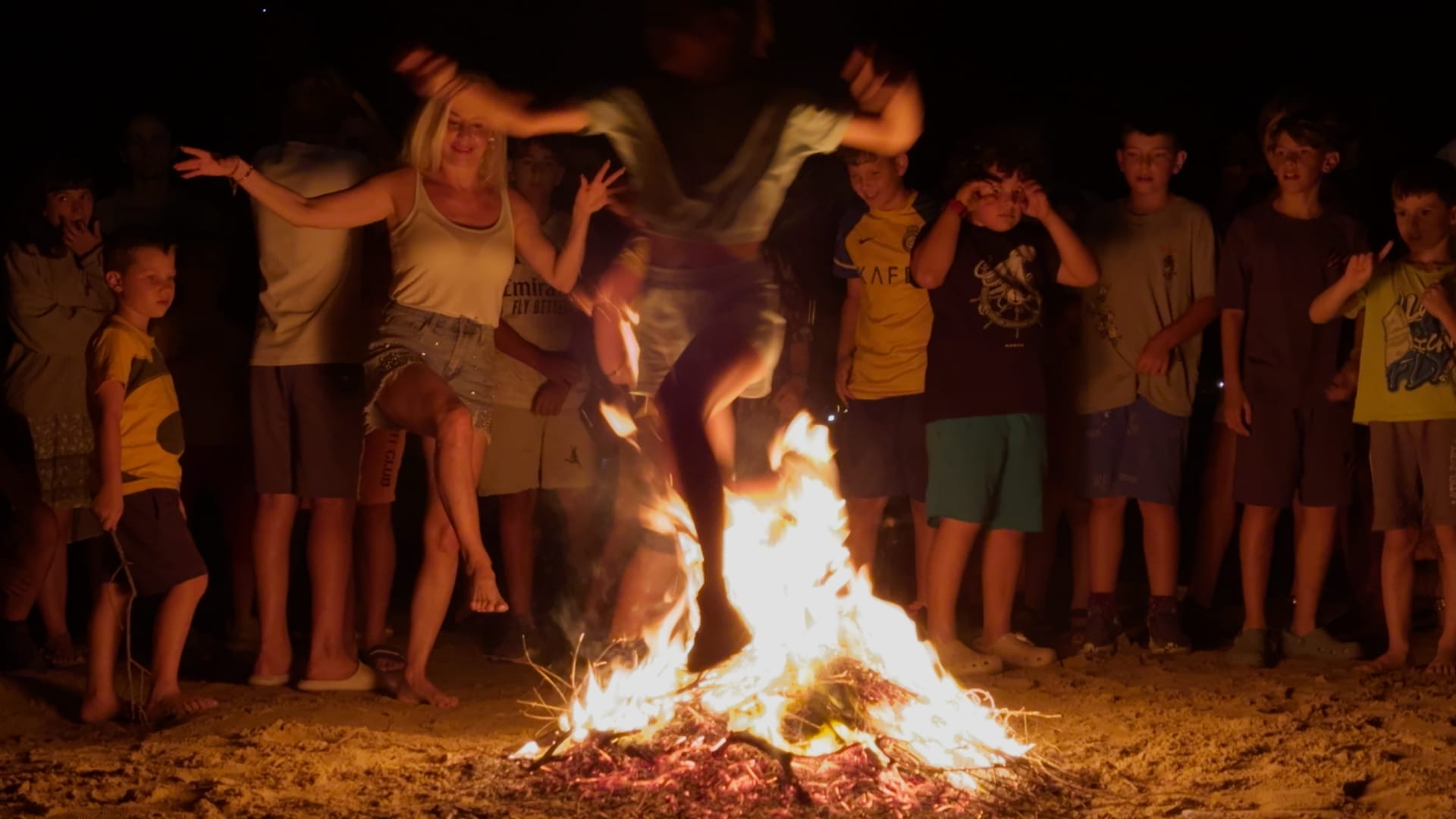
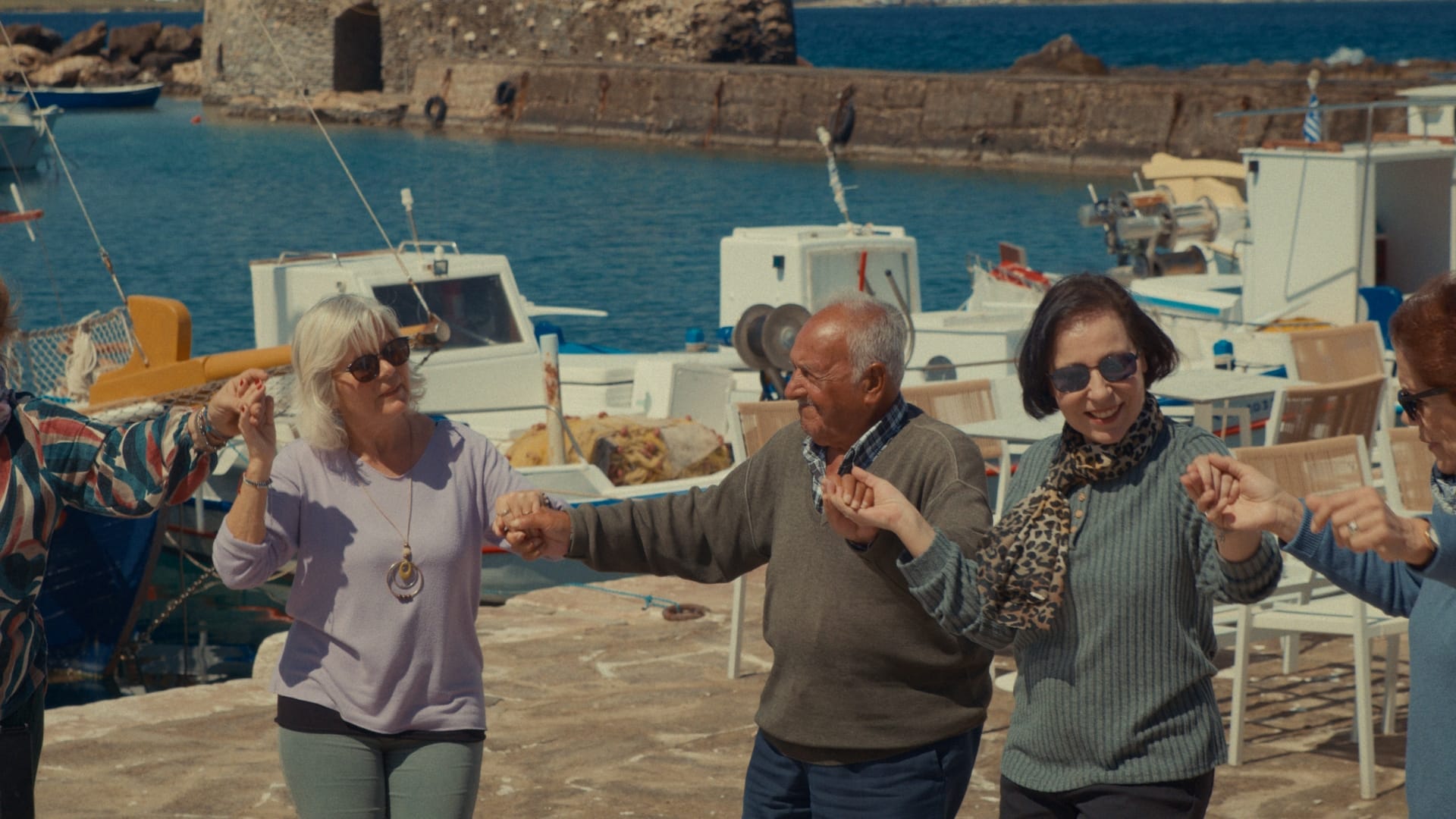
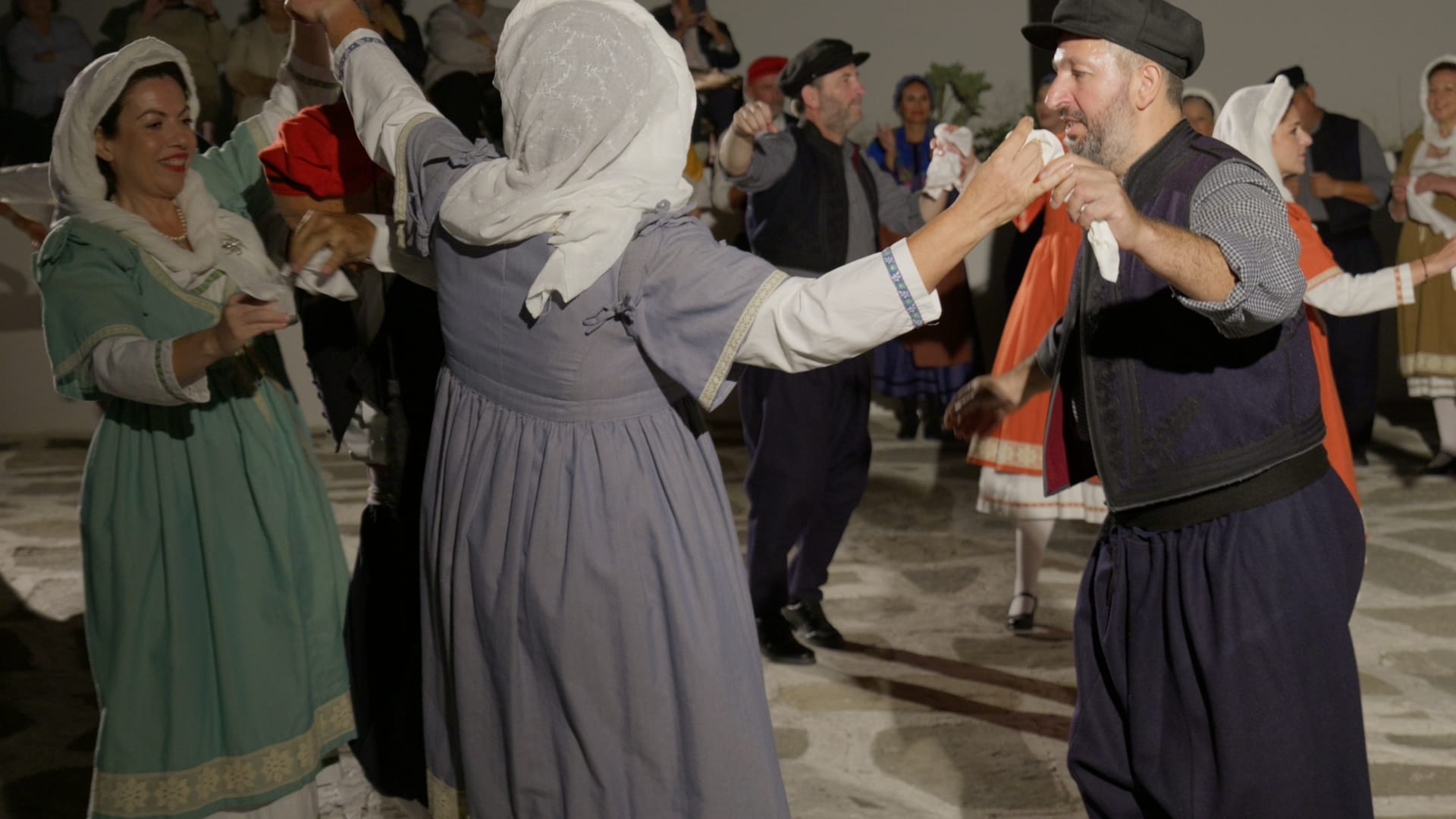
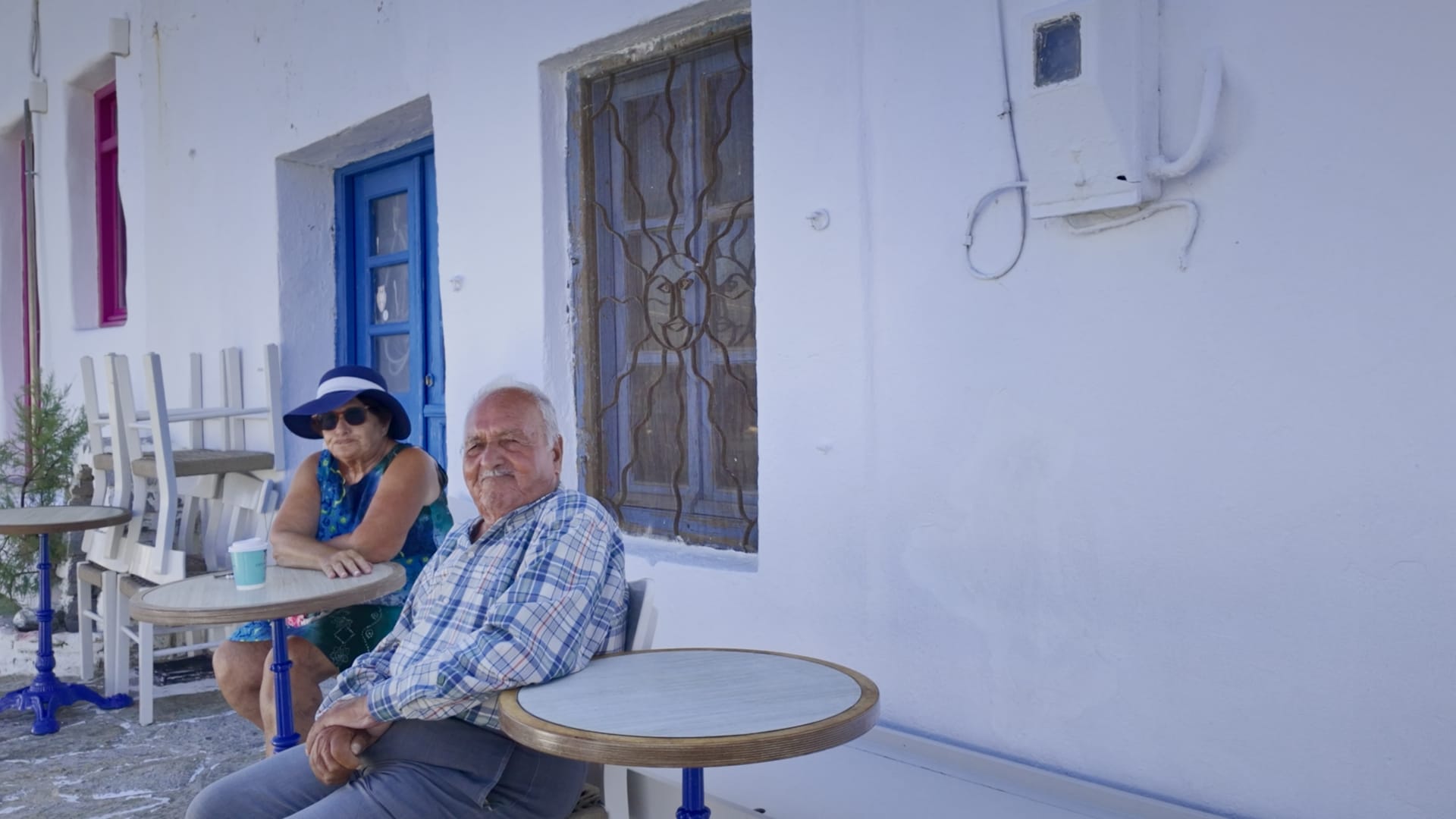
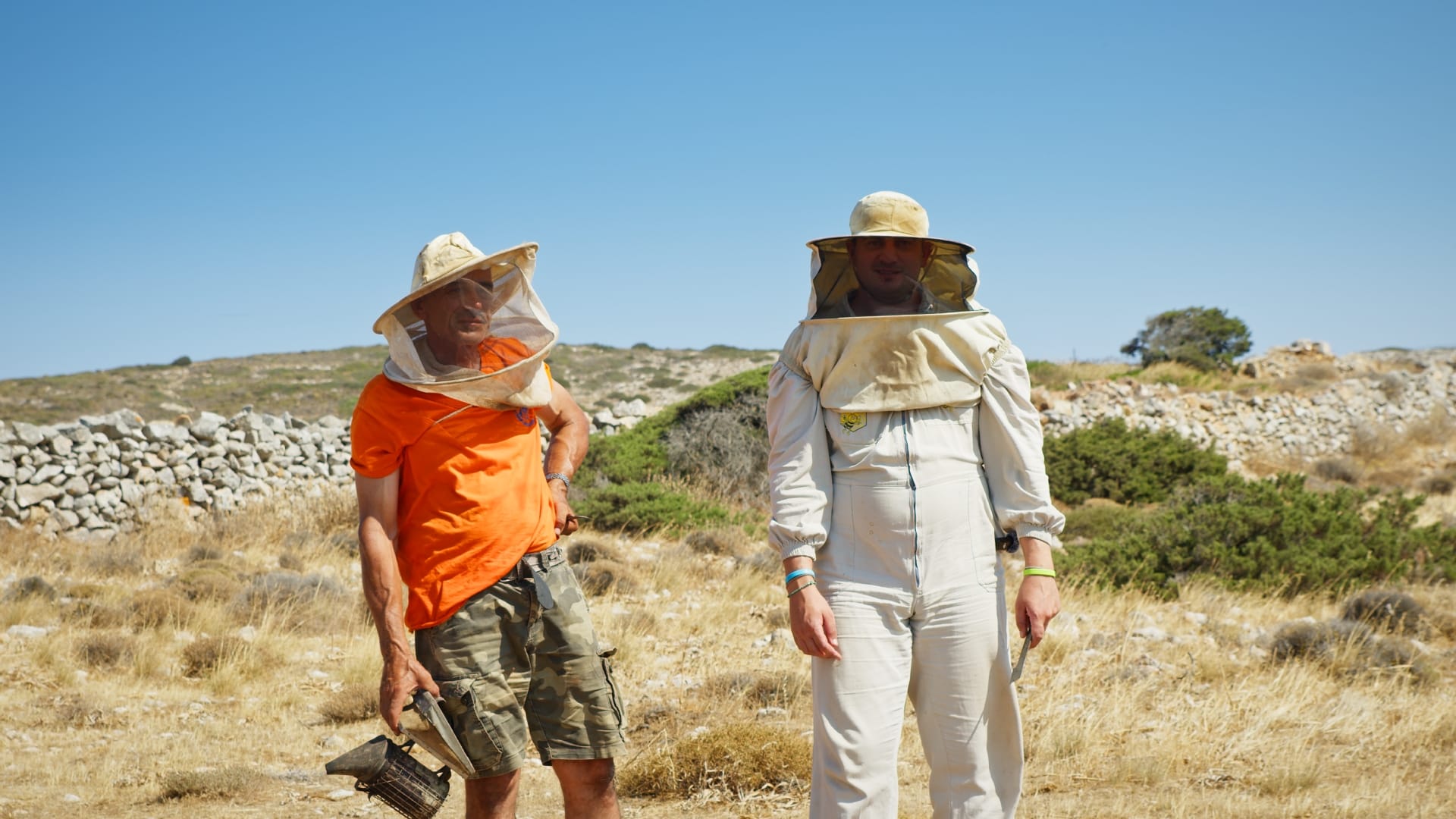
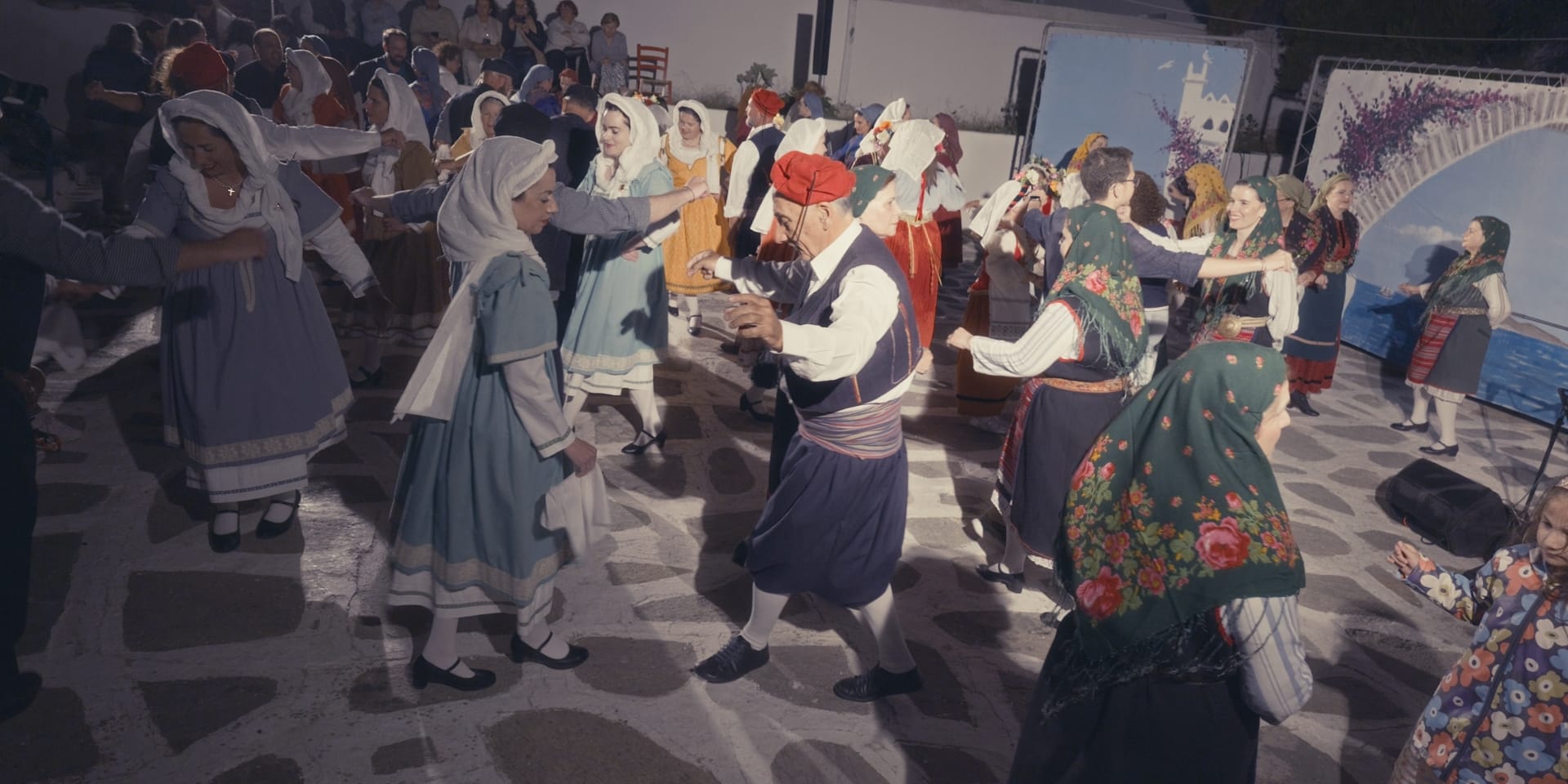
What actually happens on Paros: fire-jumping at the Klidonas bonfire in Aliki, members of the Lykeion ton Ellinidon of Naoussa dancing at the quay, folk dancers in traditional costume, Thanasis at the Naoussa fishing harbour, local beekeepers at work. © digitalparos
How to tell a tradition from a performance.
Wave the napkin if you fancy it, or go ahead and book the photoshoot, there’s nothing stopping you. As long as you’re mindful of what you’re doing, enjoy it. A few honest questions do most of the work:
- Can anyone actually explain where it comes from? A real custom survives being asked about. A manufactured one gets a shrug or a marketing line.
- Does it feel choreographed for a phone? If the moment only makes sense with a camera pointed at it, that is the point of it.
- Does it exist in more than one unconnected place with local variation, or does it trace to a single origin? Real traditions vary by village. Manufactured ones are identical everywhere, because they were built to be copied.
None of that makes Naoussa any less worth visiting or Greece any less worth loving. It makes it easier to spot the difference between what a place actually is and what it is performing for you, which, if authenticity is really what people are travelling for, might be the most useful souvenir there is.


