
The island that isn’t meant to recycle
All the plans that could have let Paros recycle its waste have failed or were never carried out. Instead comes a 27-year concession that earns more the more waste there is, and even more if it arrives unsorted, because more of it can then be sold as fuel. Paros holds 3,8% of the vote.
On the second day of a two-day conference on Paros on 14 April 2024, Dr Christos Gamvroudis spoke to a Parian audience and promised an exemplary future in waste management. The conference was organised by local associations, the municipal water utility (ΔΕΥΑΠ) and the hoteliers of Paros and Antiparos. Its title was «Στρατηγικές μετάβασης προς ένα διαφορετικό αναπτυξιακό πρότυπο για την Πάρο και τις Κυκλάδες»: strategies for a transition towards a different development model for Paros and the Cyclades. As General Director of the South Aegean solid waste management body (ΦΟΔΣΑ Νοτίου Αιγαίου), the regional authority that had taken control of the island’s landfill from the municipality three years before, he was the man who would tell us what their plan was.
The most comprehensive presentation of ΦΟΔΣΑ plans so far available is this 29-slide presentation. Almost the entirety is dedicated to how waste burial can be avoided (by means of prevention and the circular economy), starting with the individual separation (each bin being “linked” to the specific householder) and the introduction of brown bins for the collection of organic materials. Other examples cited include 35.000 composters to be handed out and 1.500 schoolchildren educated. Tilos was there, with 93% of its waste recycled or composted instead of going to landfill. So was an app on Rhodes, through which residents can book a free doorstep collection of old electrical appliances, clothes, used cooking oil and batteries, and see where the collection van is.
Burial came up twice in 16 minutes: once as the failure to be corrected, «σήμερα θάβουμε περισσότερο από το 90% των παραγόμενων αποβλήτων μας», today we bury more than 90% of the waste we produce, and once as the only Paros project on those slides with a date attached to it: a second phase for the landfill, a new cell to bury more in.
It’s been 29 months since those slides, and the landfill cell is the only project on them to reach a construction contract. What happened to the rest is connected to what is being built in their place, and the connection isn’t incompetence.
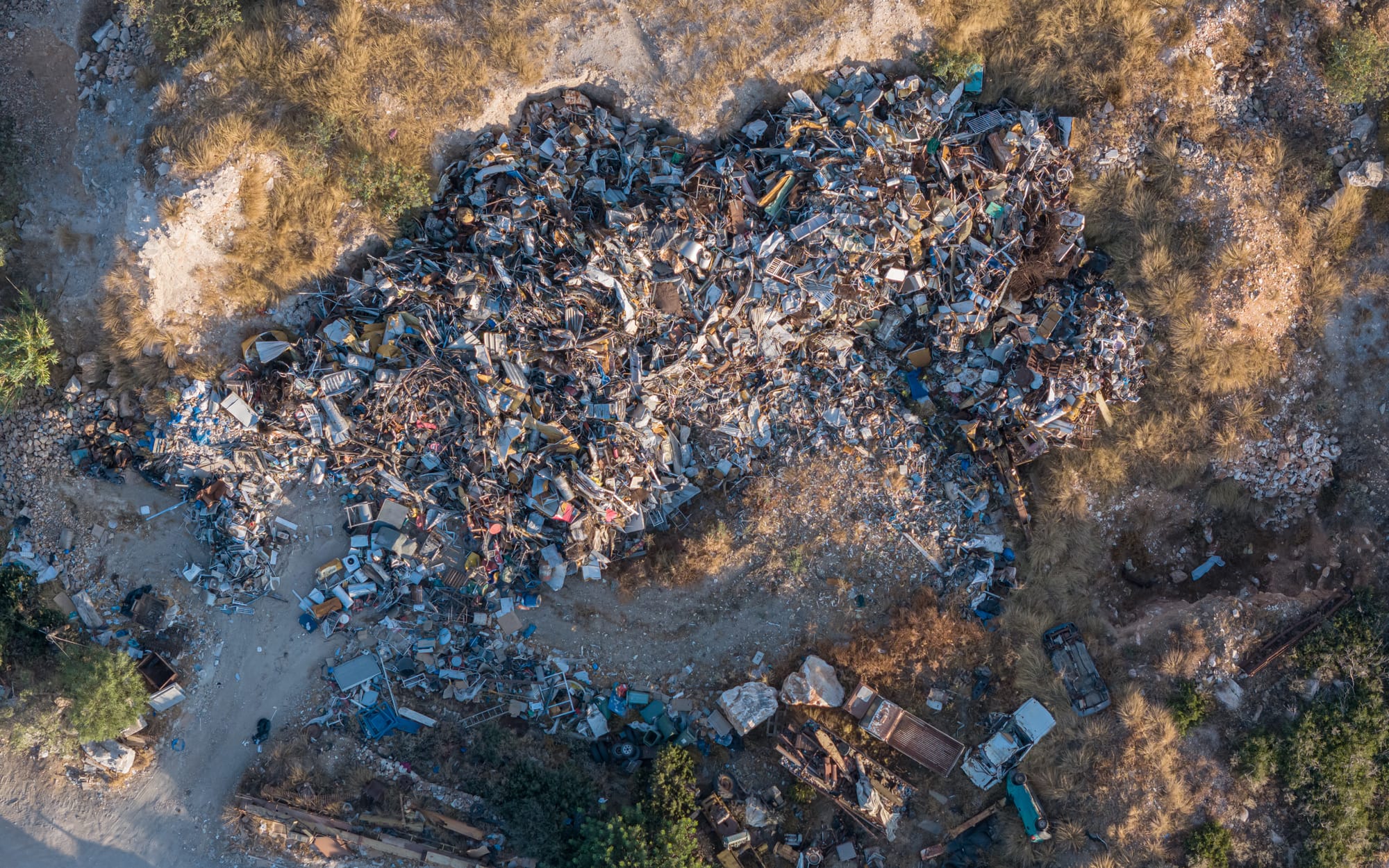
All attempts to reduce unsorted household waste have either failed, been defunded or never even been put out to tender. In contrast, the island is part of a 27-year, €194,92 million concession, currently out to tender. As designed, the operator will be paid according to how much waste it handles, and will be entitled to sell the burnable remainder as fuel. Both of these sources of income grow if waste comes in unsorted.
There’s no reason to break any rules for the system to work this way. The incentives do everything.
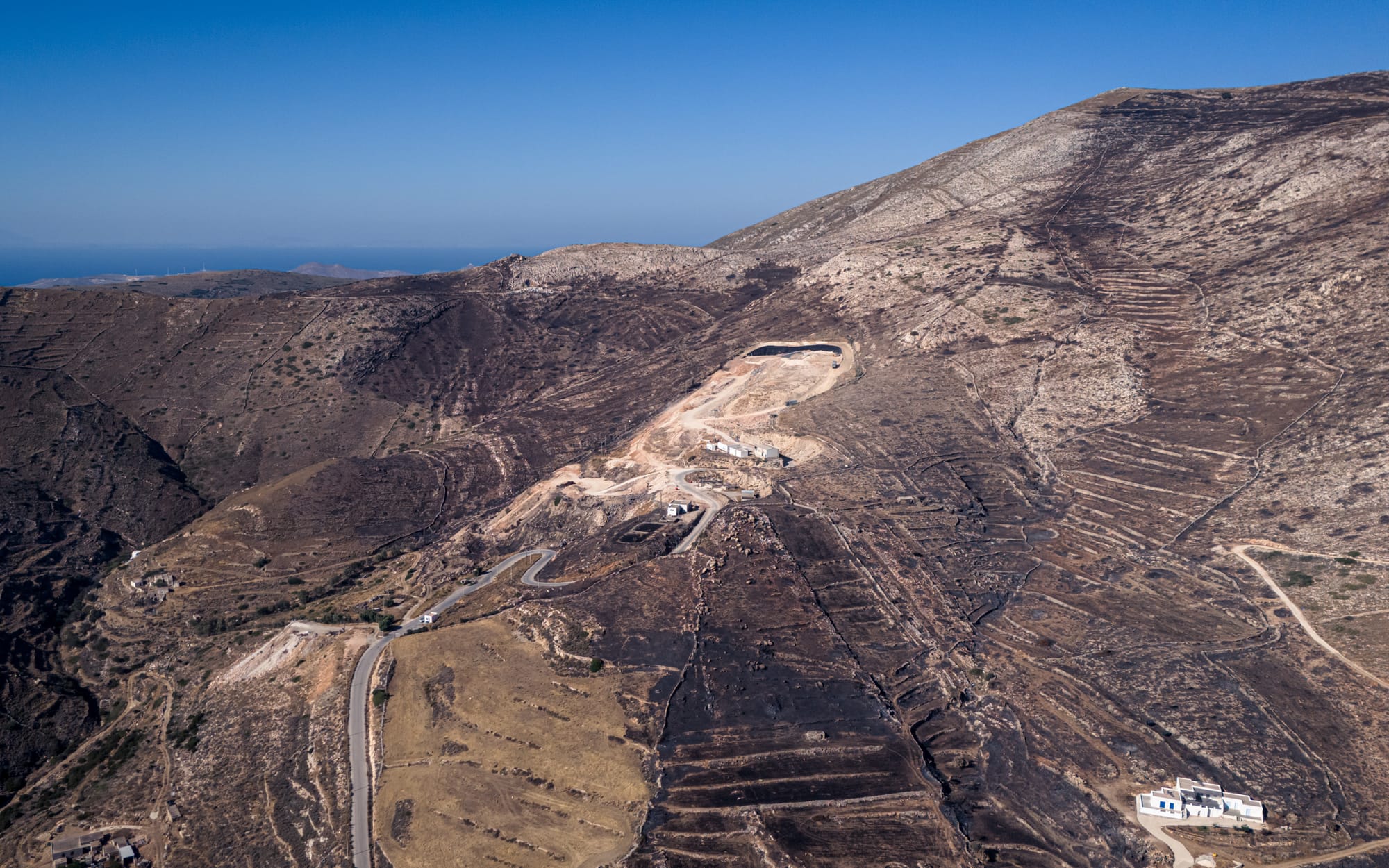
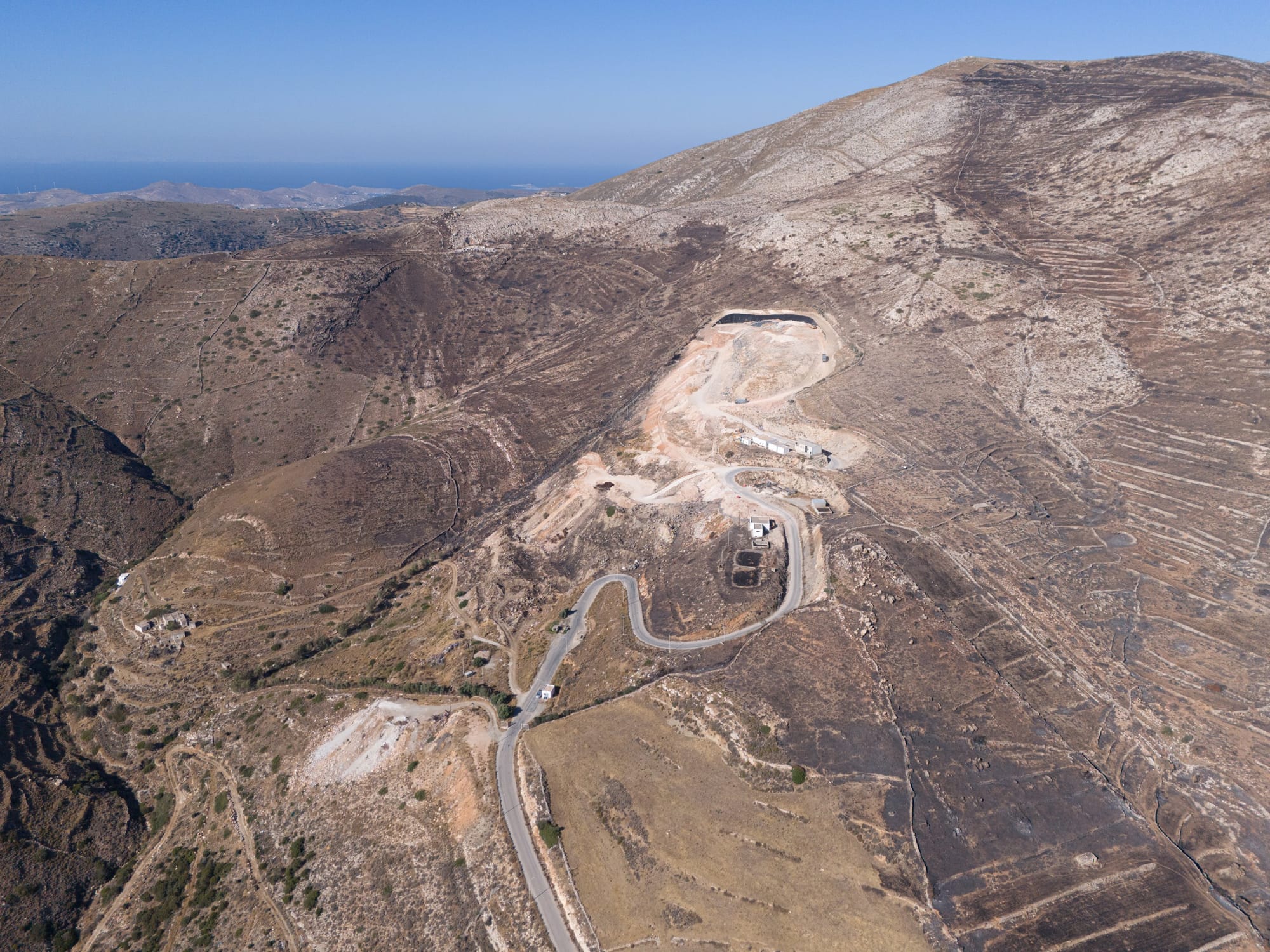
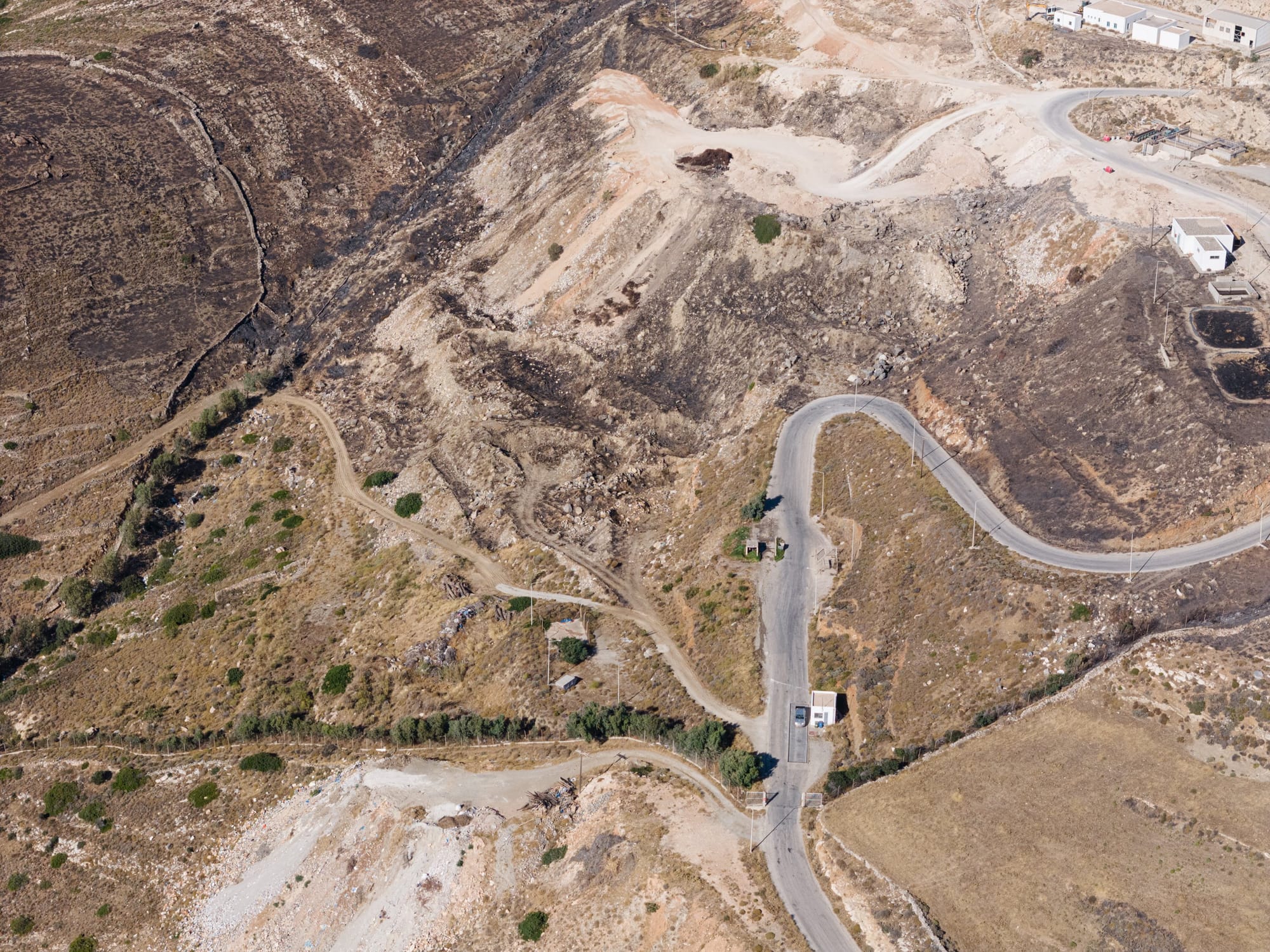
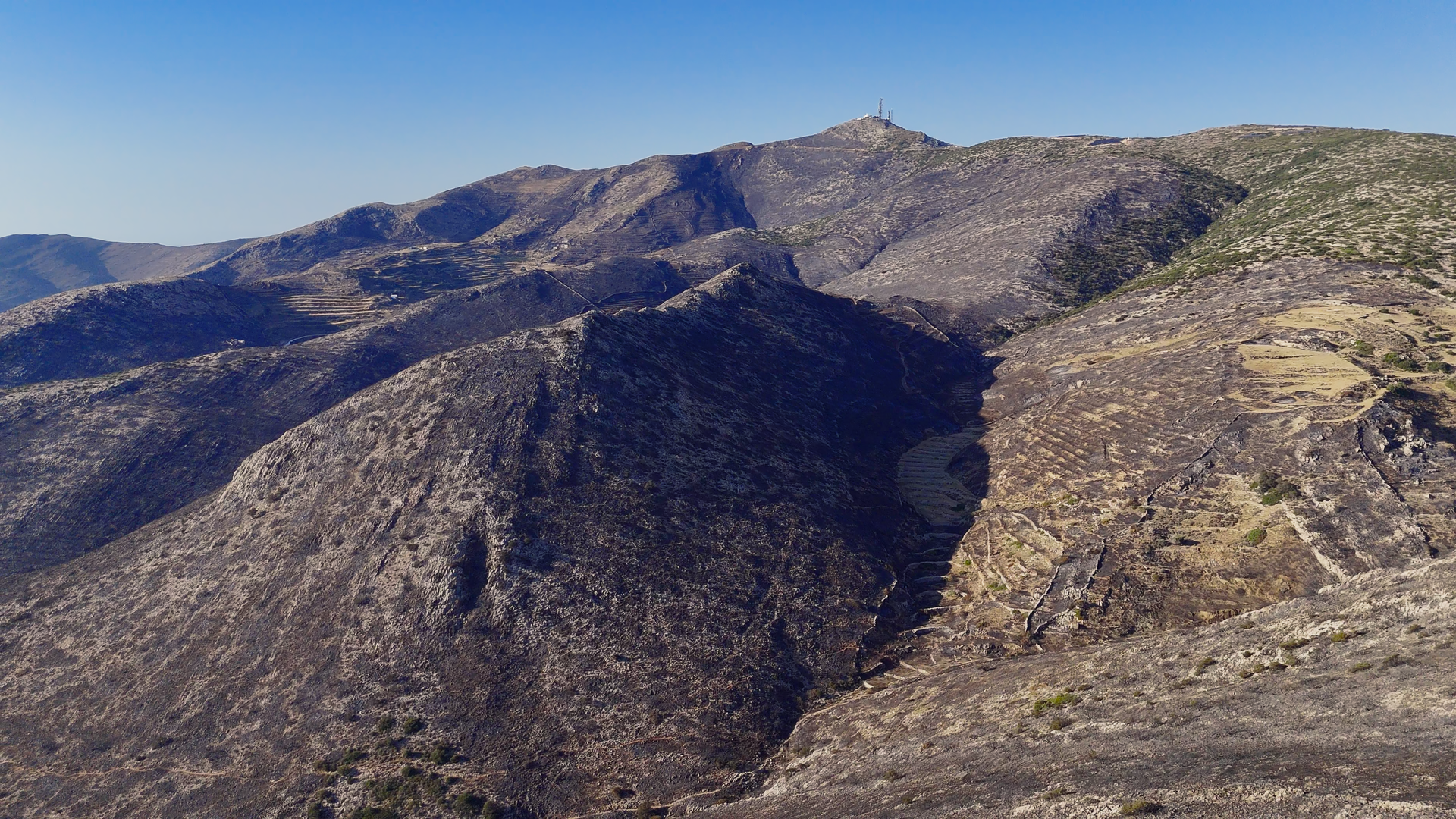
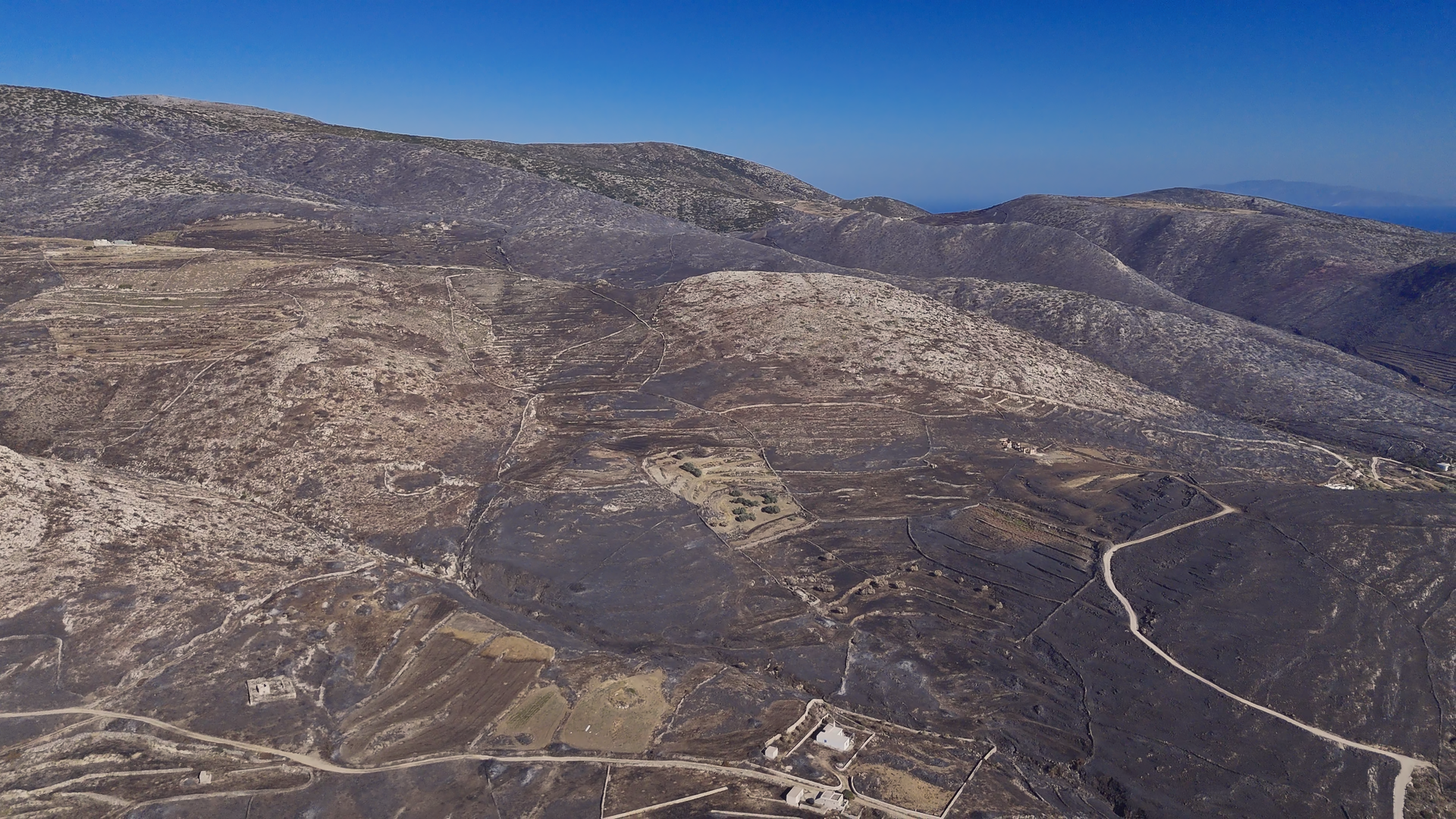
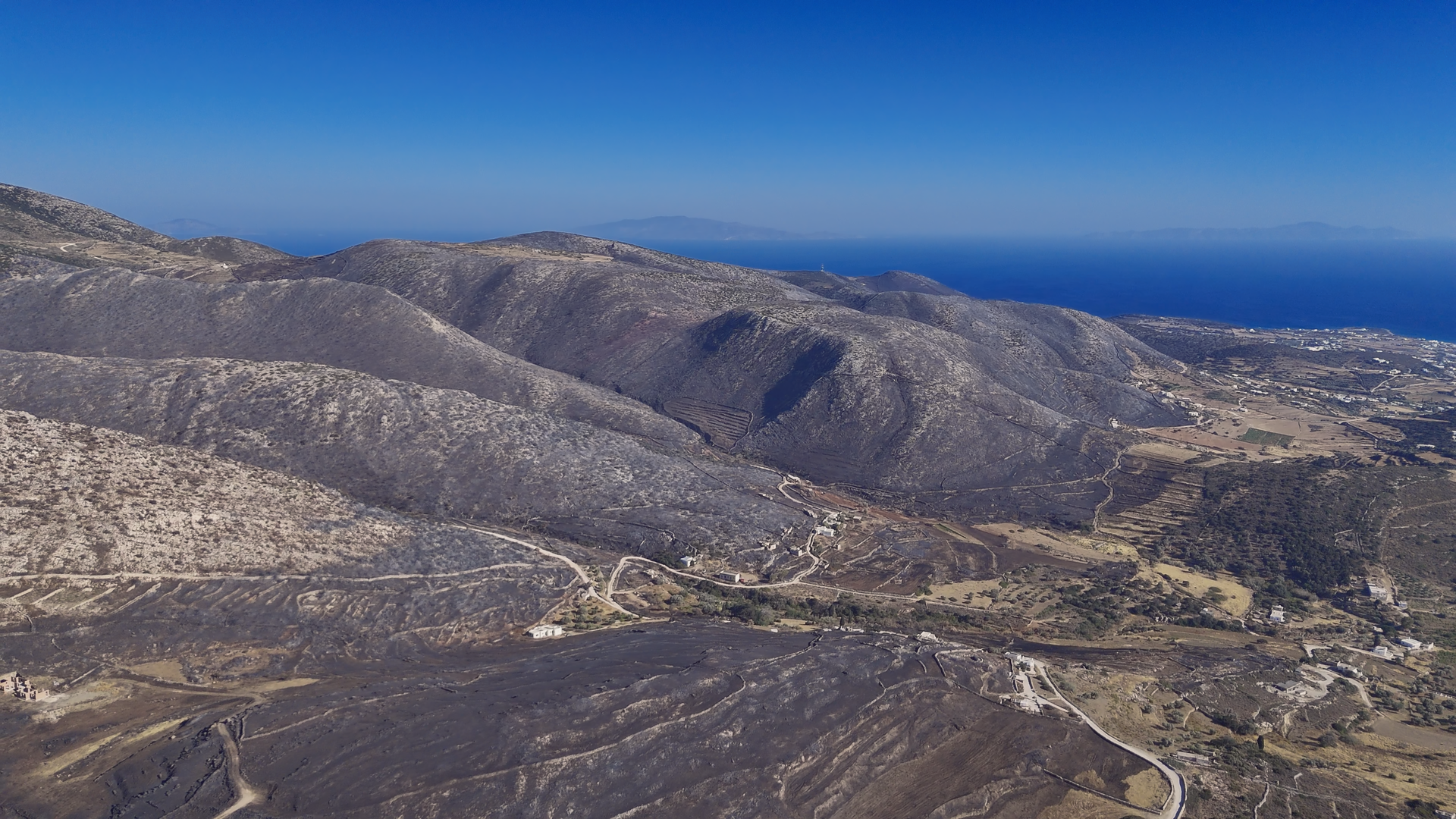
The landfill at Agios Charalambos from the air, photographed in early August 2026, a few days after the fire. On 3 August the state declared a civil protection emergency here, citing hazardous pollution. The burned ground in these frames is hillside outside the site: what “over 10.000 stremmata”, more than 1.000 hectares, looks like from above. ©_digitalparos
On 28 July 2026, the landfill at Agios Charalambos caught fire and burned over 10.000 stremmata of the island. That is over 1.000 hectares. On 3 August, the state declared a civil protection emergency for the island at the municipality’s request, citing hazardous pollution. Mayor Costas Bizas had been arrested on 29 July, while the fire was still burning. He considers his arrest unjustified. Antiparos, which uses the Agios Charalambos landfill because it has none of its own, asked its residents the day after the fire not to use their bins. The neighbouring island has been under its own emergency declaration since August, on the same hazardous-pollution grounds as Paros, running to 10 November.
It’s up to the courts to determine who was at fault for the fire, and the criminal proceedings are moving forward. But a far more interesting question, one that no court will ever address, is how the community of 15.000 residents ceased to have any say in how its waste would be disposed of, and what it has been subjected to now.
The year the island stopped deciding
For years the landfill was run by the joint waste association of the municipalities of Paros and Antiparos (ΣΥΔΙΣΑΠΑ). Its methods were unsophisticated, but by putting its procurement contracts out to tender, it secured discounts of between 10 and 25%. The management lived on the islands the landfill served. That all changed in 2021.
The handover was mandatory. On 26 March 2021, the landfill and all assets of ΣΥΔΙΣΑΠΑ were transferred to ΦΟΔΣΑ Νοτίου Αιγαίου, the regional body for waste management that covers the entire region from here to Rhodes, removing control of the island’s waste disposal from local authorities. The transfer was signed by Mayor Markos Kovaios for the municipality and by Georgios Chatzimarkos for ΦΟΔΣΑ, and a sum of €159.091,35 in cash went with it. The municipal council later said it never saw that money accounted for.
Since ΦΟΔΣΑ is structured as a company, all the important decisions (such as the setting of the prices of its service and the yearly contribution of each municipality) are taken in the shareholders’ meeting, the General Assembly. There, Paros and Antiparos together hold about 3,8% of the voting shares, while the Region controls 40%. The chair of the General Assembly is the Regional Governor. In 2022, the Paros council voted against the prices policy of ΦΟΔΣΑ and reserved its right to legally leave ΦΟΔΣΑ. An empty threat, though.
At 3,8 per cent, you have no real say in anything that gets decided.
Costs rose immediately. The municipality’s own planning office noted the cost of running the landfill grew from €280.000 in 2020, ΣΥΔΙΣΑΠΑ’s last complete year of operation, to an expected €984.000 in 2023, or more than 3½ times as much in just three years.
Some of the increase is due to a tax levied by Greece on all landfills by tonne, which ΦΟΔΣΑ collects and forwards to the Hellenic Recycling Organisation (ΕΟΑΝ) [1]. It started at €20 per tonne in 2022, so it isn’t in the €280.000 base year, and it would have applied to ΣΥΔΙΣΑΠΑ too. From 1 January 2026 the amount increased to €45/tonne, rising further to €55/tonne from 1 January 2027.
The point of the fee is to make burying waste expensive and less burial attractive. But it makes no sense if there’s no place for the waste to go instead. And on Paros, there is no such place. Thus the charge is simply a cost, and nothing more, and is transferred to households via their municipal tax in proportion to their square metres of property, not their rubbish.
If your household does all the sorting, or no sorting at all, the cost to you is identical. Here the “polluter pays” principle applies only between institutions, but not at the household level.
It was not always meant to be like this. The draft contract ΦΟΔΣΑ’s board approved for Paros in March 2021 bound ΦΟΔΣΑ to supply the municipality with recycling cards «με στόχο την εφαρμογή κινήτρων και αντικινήτρων στους πολίτες», to apply incentives and disincentives to citizens, and it named the system it had in mind: «Σύστημα Πληρώνω Όσο Πετάω». Pay as you throw. That contract was never signed, and Paros never got the network that came with it.
All of the things that would have reduced mixed waste
There are six ways to reduce the amount of unsorted waste an island produces: producing less rubbish in the first place (businesses and households), sorting it at source (households), collecting it separately (the municipality), drop-off points that accept separately collected rubbish (the municipality), composting organic waste (ΦΟΔΣΑ), and sorting recyclables to sell on as raw material (ΦΟΔΣΑ). Each has had a funded project on Paros since 2021. None of them is working. Taken one at a time, each looks like ordinary administrative failure; taken together, they amount to the destruction of an alternative.
The recycling network it was left out of
(εκτός Πάρου & Νάξου - except Paros & Naxos). This was a note in brackets on a slide further into the same April 2024 presentation, on investment and expenditure. ΦΟΔΣΑ was planning to spend €40 million on infrastructure for the separate collection of recyclables in the South Aegean: 771 “neighbourhood recycling points” that could tell which households were taking part, 30 “collection and education” vehicles, 14 “mobile” shops for second-hand items, 18 hook-lift trucks and 163 containers. All of it would be managed centrally with “digital technology”, through a “digital platform for monitoring the process of separate collection” and the “awarding of bonuses” for taking part. The presentation went into detail on how much each municipality was getting.
Except Paros and Naxos.
Naxos had never been in it. Paros had. And three years before that slide was put up, on 24 March 2021, ΦΟΔΣΑ’s very own board had gone through each of the 32 municipalities individually, and voted to approve, as item 34 on its agenda, a draft contract with the Municipality of Paros to build precisely this network here. A 10-year contract with an option for another 10: ΦΟΔΣΑ would be responsible for running the tender, buying the equipment and handing it over free of charge; the municipality would install it, operate it, provide fuel for it, service it and revise its cleanliness regulation to match. Two days later, Kovaios signed the mandatory handover of the landfill to ΦΟΔΣΑ.
The contract for the network, however, was never signed and Paros remained outside it. About twenty other municipalities, Antiparos among them, approved their own agreements that spring. What Gamvroudis told the room in 2024 was one sentence long: «Δυστυχώς, η Πάρος και η Νάξος ήταν δύο νησιά που δεν θέλανε να συμμετέχουν σε αυτή τη δράση.» Unfortunately, Paros and Naxos were two islands that did not want to take part. He added that he hoped to talk about joining with «τη νέα δημοτική αρχή», the new municipal authority, which had taken office 15 weeks earlier.
According to the mayor, this discussion never took place. In a telephone conversation with us on 17 September 2026, Bizas said that ΦΟΔΣΑ had never contacted him about joining the network and that virtually none of what was announced that day came to fruition.
ΦΟΔΣΑ’s own documents bear him out on the network. In October 2022, the regional waste plan referred to it as “a project proposal for funding”. In its February 2026 plan for separate collection, ΦΟΔΣΑ wrote that «δεν έχει αναπτυχθεί ακόμα επαρκές δίκτυο», no adequate network of recycling points has been developed yet, and that nowhere in the region are there vehicles to empty them. It goes on to list the recycling points operating, or due to start operating. Three, all of them on Antiparos. Out of the 771, three. And the same plan now asks for about €40 million again, for a new separate-collection programme.
We asked Kovaios why Paros didn’t sign and he hasn’t answered us. We don’t think he will. Kovaios heads the opposition on Paros. When the waste issue turned into a political dispute following the blaze, he chose to blame the mayor and not the Region. If he were to respond to us, it would mean he’d be taking aim at both ΦΟΔΣΑ and the Regional Governor.
The organics package that vanished
Whatever happened in March 2021, it wasn’t a refusal to separate waste at source. On 23 June, three months later, the finance committee of the municipality, Kovaios in the chair, voted unanimously to apply to the same European operational programme for the other half of source separation: a waste transfer station of about €1.680.000, a separate biowaste collection network for Paros and Antiparos worth €637.454,61, and €165.000 to buy land for a composting plant. Brown bins, collection vehicles, a truck for green waste. This decision doesn’t bypass ΦΟΔΣΑ either. It lets ΦΟΔΣΑ submit the full application, naming the municipality as beneficiary for the three parts that were its own. It also notes that ΦΟΔΣΑ would submit the remaining parts: the landfill expansion, and the composting plant the organic waste would go to, which already had its environmental permit and whose final design study was nearly complete.
The municipality bought the land, measuring 13.766 m² beside the landfill, using its own money in November 2021. The €165.000 was meant to pay it back: the June decision records that the purchase was already under way and that Paros was asking the programme to finance it. In December 2023, the State released a declaratory act allocating the plot of land to ΦΟΔΣΑ, which was published in the official government gazette on the grounds that the municipality had purchased it using its own money. But 10 days later, and 16 days before Kovaios left office, his council took the matter up as urgent business outside the agenda and voted unanimously to ask the municipality’s lawyer to study an appeal to the Council of State, and present the results to the finance committee, which would no longer be part of his administration when that report was due.
And there is no mention of the transfer station or the €637.454,61 biowaste network anywhere else either. Of all the items the committee approved unanimously that day, only one still remains: a vacant plot of land next to the landfill.
The composting plant that is still paperwork
That facility, the biowaste treatment unit (ΜΕΒΑ) [2], is designed for 1.500 tonnes of biowaste per year and was granted permission in 2021. In April 2024 Gamvroudis used just two words to describe it: «Προς Δημοπράτηση». Fully funded, just waiting to be put out to tender. Five years after its approval the project still doesn’t have a construction tender (the study cost €29.500 and the consultancy €17.820, so €47.300 spent on paper) while the burial part of that same programme has a contract of €7.114.893,56 plus a commitment to operate for the next six years.
But then again, it is possible to do both at once. Milos, a smaller island, signed a single contract, worth €3 million for both its landfill and composting unit in January 2023.
The Green Points that were defunded
Meanwhile, the Green Points, centres where residents can bring their well-sorted waste (paper, glass, metal and packaging, textiles, small electricals, batteries and garden waste) have yet to materialise. Back in June 2022 the government approved funding (€1,99 million) for the construction of two of these centres (in Parikia and in Naoussa). The tender was completed back in December 2023, but approval to proceed was not granted until 15 months later (in March 2025) and the contract of about €954.000, for the buildings only, was then signed in April. The equipment needed to run them was left to a second phase of about €756.000, which has never been put out to tender.
Works finally started in July 2025. Only in Naoussa but not yet in Parikia. However, they came to a halt when the state stopped payments (the fifth instalment, of around €287.000, has not been received). To keep the worksite from standing idle, the municipality has since covered approximately €338.000 from its own resources. Nevertheless, the contractor filed a formal protest. Finally, on 17 December that year, the entire project (works, buildings and equipment) was delisted, with assurances that a new call would be announced within 15 days. Almost ten months later, there is still no call.
In May of this year, the mayor sent a letter to a minister, followed by one to the prime minister in August, neither of which led to a response. ΦΟΔΣΑ’s February 2026 plan for separate collection still counted the two Green Points as scheduled, two months after they had lost their funding, and so budgeted no new ones for Paros. When the ministry reviewed the plan in March, it required those same two to be included. On paper, both documents count them. Neither pays for them.
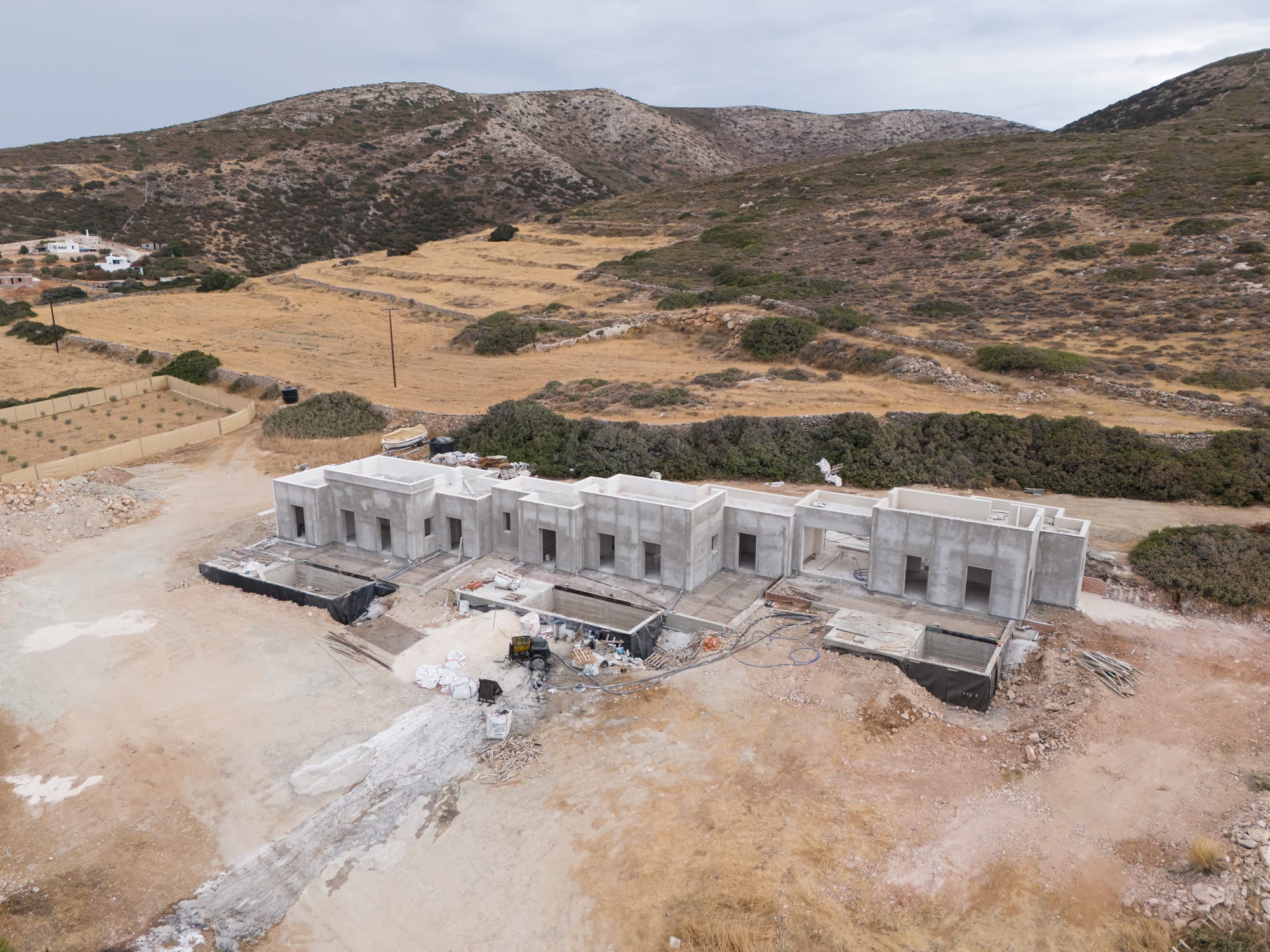
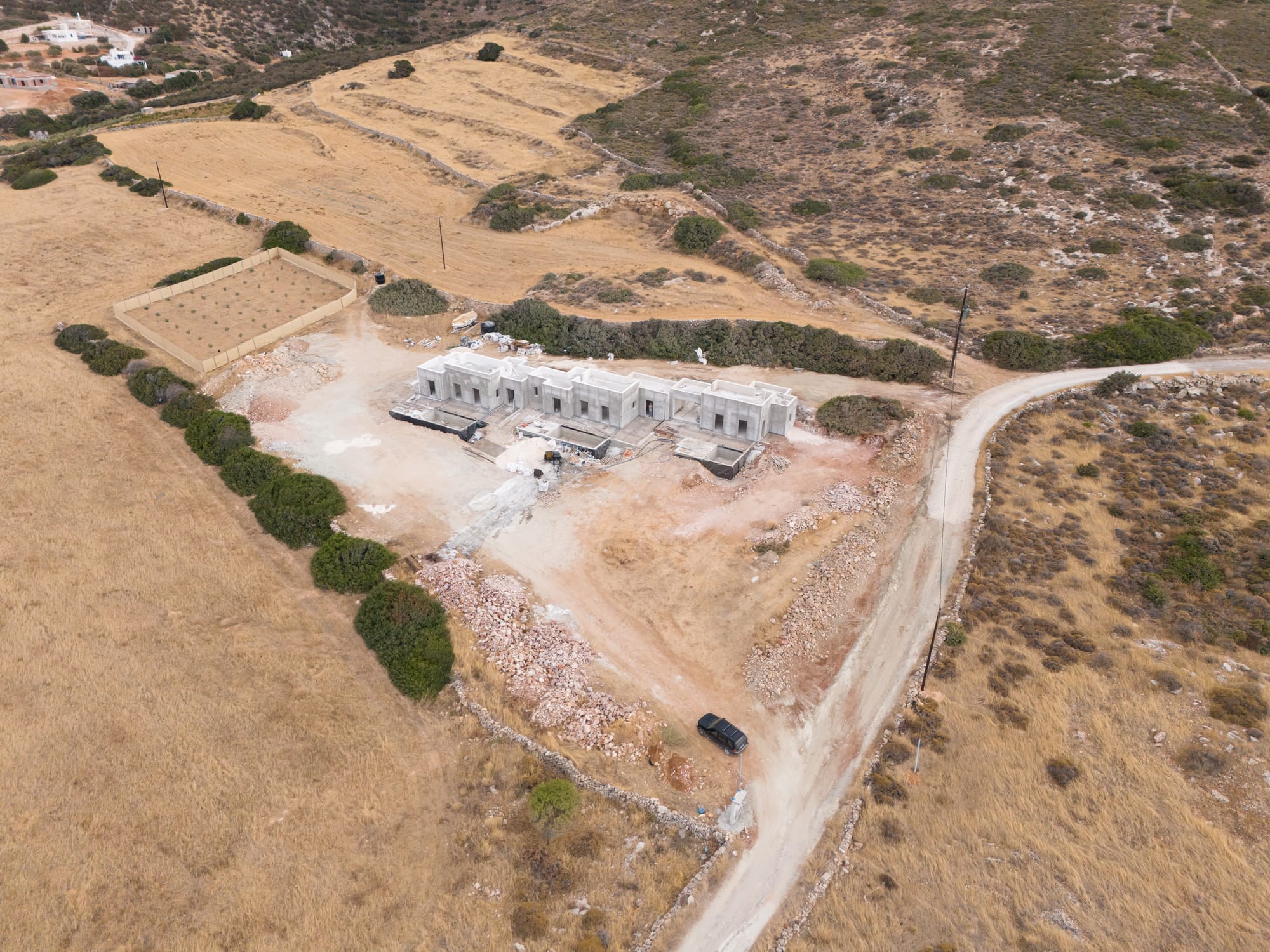
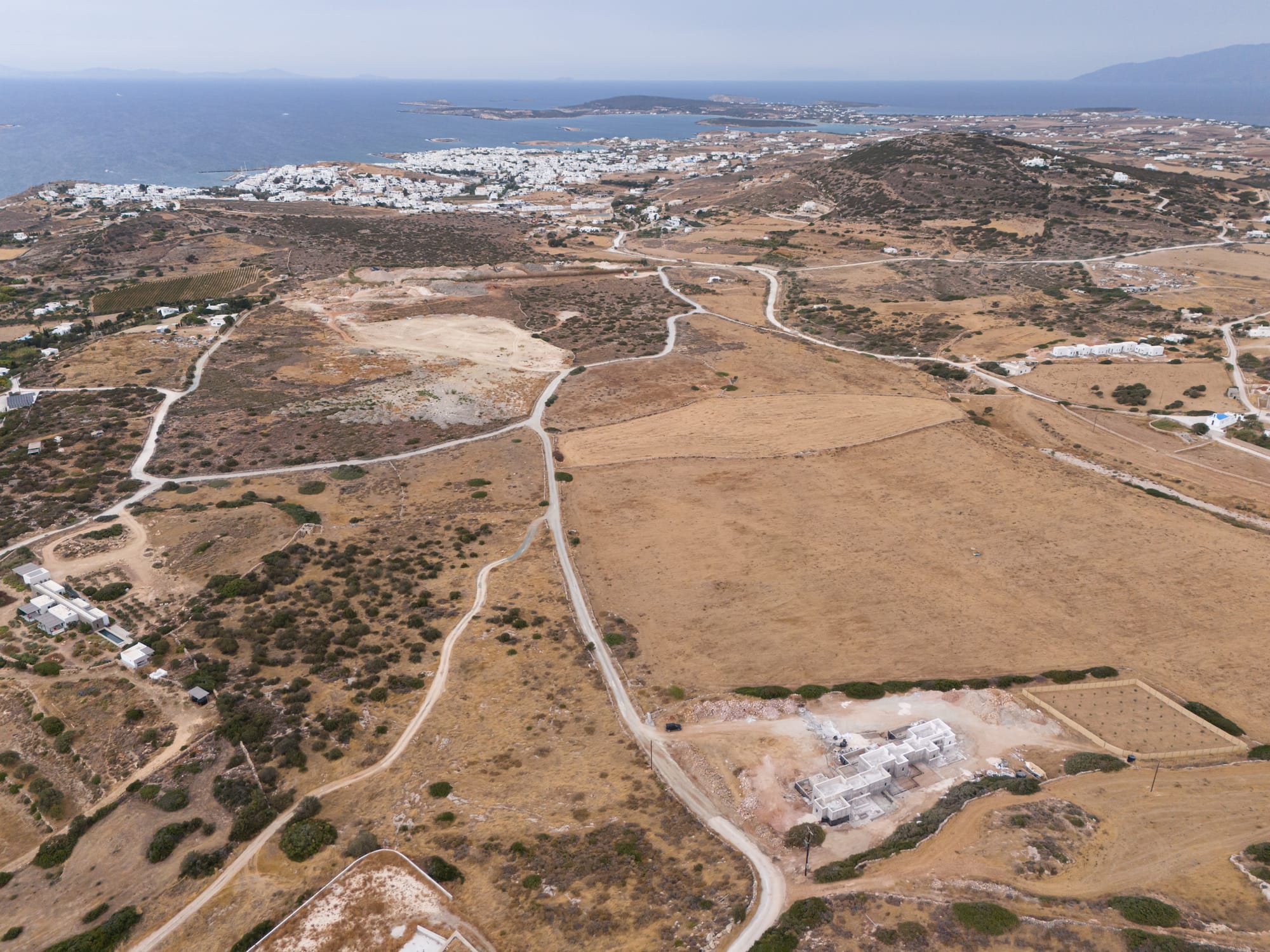
The Green Point in Naoussa, construction of which started in July 2025 but then stopped after the state’s fifth payment of some €287.000 did not materialise. The contract covered only the construction of the buildings. Equipment to operate them was to be supplied under a second stage of roughly €756.000 that never went out for tender. The project was dropped from the funding programme on 17 December 2025 and a new tender was supposed to be issued within 15 days, but it still hasn’t come. ©_digitalparos
The composters that are dryers
One part of the composting promise was kept, and it is the only part that was. ΦΟΔΣΑ promised Paros 533 small electric composters and 1.253 garden composters of 300 litres. And Gamvroudis mentioned to the participants that day that he expected Parians to have them in their hands before the end of the year. However, ΦΟΔΣΑ opened bookings for them 10 months late, on 31 October 2025. And then, on 22 April 2026, it told everyone who had already booked to book again. That was five days before the units were delivered to the distribution points where nobody checked bookings anyway. We got two without anyone asking about our booking.
The 533 small electric “composters” are really just dryers. Each one uses 600 watts, and takes seven hours to reduce 2 litres of food scraps to a dry grind. That is not the «λίπασμα» (fertiliser) for your flowerpots that the room was promised. So each one that gets used will add hundreds of kWh per year to its electric bills while refuse will continue to be charged on a square-metre basis. On the extremely optimistic assumption that half of all 1.786 units will be used once per week, they’ll keep approximately 4% of the food and garden waste generated on the island out of the tip, representing a tiny minority (just under 2%) of all the rubbish that we chuck away.
And the sorting centre that closed
In April 2025 ΦΟΔΣΑ put the island’s recycling contract out to tender for the first time since the sorting centre opened in 2015. Two companies made submissions for the tender that had a procurement value of €294.060 but both of these were disqualified on appeal. In relation to WATT, the Single Public Procurement Authority (ΕΑΔΗΣΥ) [3] gave three separate reasons for rejecting their technical proposal. The proposed sorting line did not include a magnet, which is a legal requirement, there was a lack of information on contamination and most tellingly they failed to submit any information on health and safety. The entire section was missing and the authority ruled that this gap cannot be rectified after submission.
On 17 November 2025 the board of ΦΟΔΣΑ terminated the entire tender because there were no valid bids remaining. No award, and no relaunch since then. Thus, since that date, the island has been without a legal operator for recyclables.
WATT’s announcement in March 2026 that it would stop running the sorting centre, made in a letter to the municipality and to the Hellenic Recovery Recycling Corporation (ΕΕΑΑ) [4] saying the arrangement had become “economically unfavourable”, was simply the public confirmation of a de facto reality for four months.
In a press release dated 20 August, WATT said it had been letting the mayor and relevant authorities know about its decision to exit since early 2024, having lost over €300.000 in the interim. But WATT bid for the contract in April 2025, over a year later, and a firm which is planning to exit would rarely bid to win the contract.
When asked again about the closure in September 2026, WATT A.E. CEO Thanassis Katris stated that the tender “was not completed, because the Single Public Procurement Authority accepted a competitor’s appeal”. In fact, the authority did decide to accept the appeal, and that appeal was that WATT’s bid had failed to comply with three mandatory criteria. The sorting centre ceased operation on 30 April 2026. It took 11 weeks to sign a new contract with ΕΕΑΑ for the recyclables of Paros to be transported to Attica. The signing finally took place eight days before the fire. During those 11 weeks, anything separated on the island had nowhere lawful to go, so it was stockpiled at the landfill site.
That stockpile is where the fire started.
The arrangement that replaced the sorting centre is no cheap solution, and the island foots the bill. Back in September, the mayor told the council that the cost of sending the blue bin to Attica amounts to some €600.000 per year. It’s drawn from the very same ring-fenced waste fees that cover everything else. From the roughly €35 million municipal budget, around €10 million is from those fees, and that is what funds the staff, the private collection contracts, recyclables, and the municipality’s yearly payment to ΦΟΔΣΑ for the landfill. On 22 September the public broadcaster ΕΡΤ asked him on its programme Φάσμα (Fasma) whether that would be added to municipal fees. «Προφανώς» (“Obviously”), said the mayor, because cleaning is ring-fenced and must be self-financing.
So, about one euro out of every sixteen in the island’s waste budget now goes to sending unsorted recyclables on a ferry. That is either subtracted from collecting the island’s rubbish, or tacked onto each household’s bill.
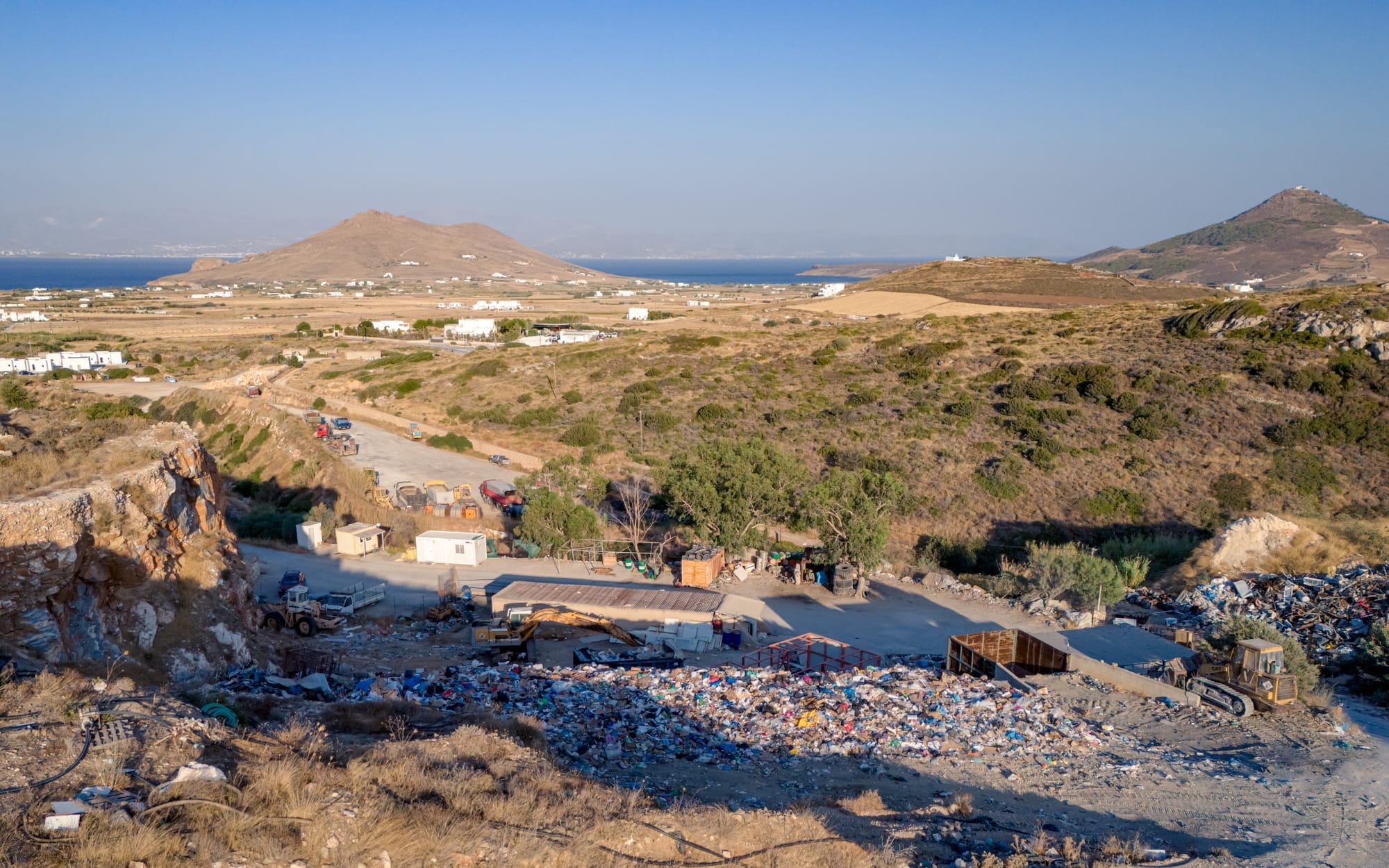
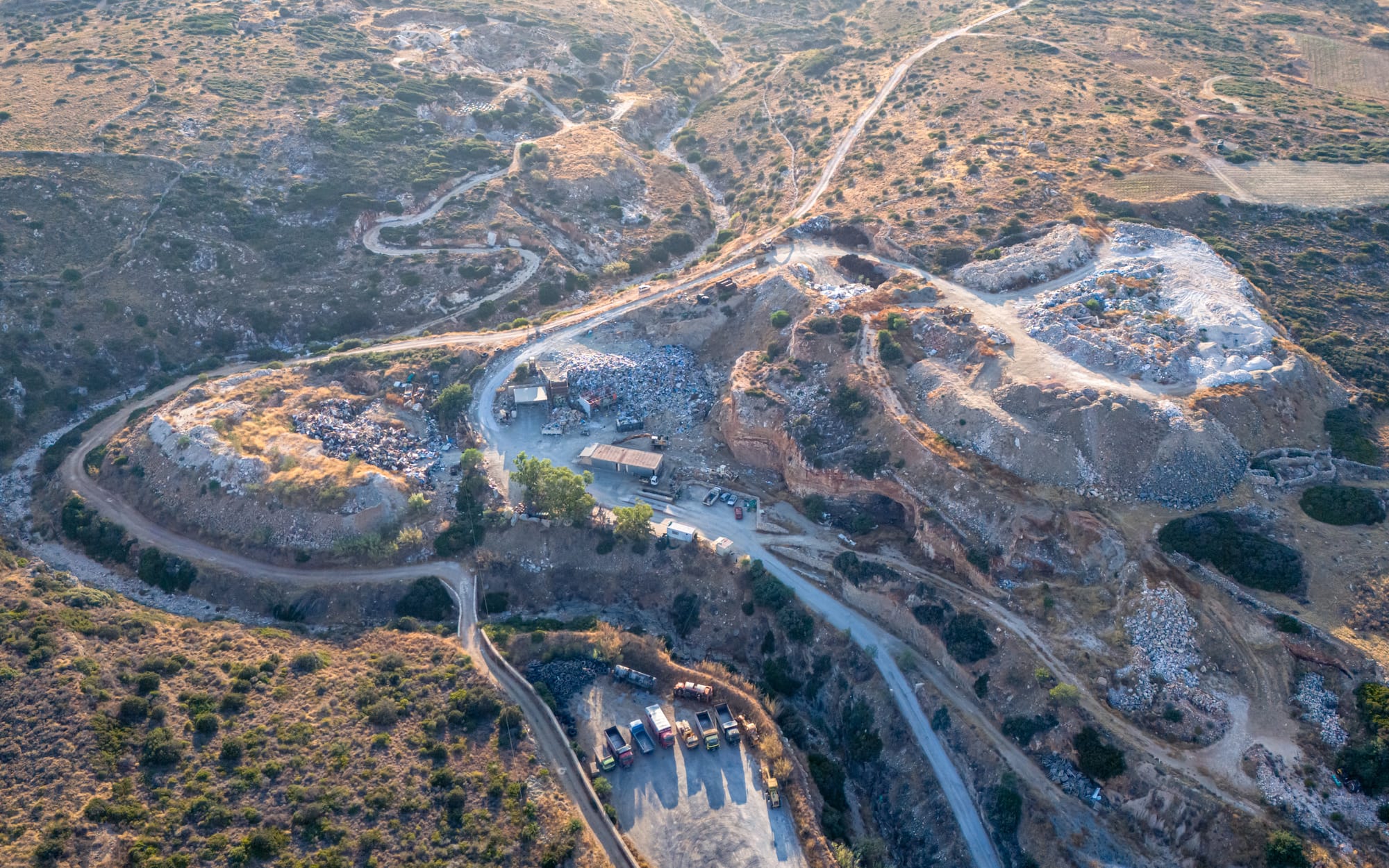
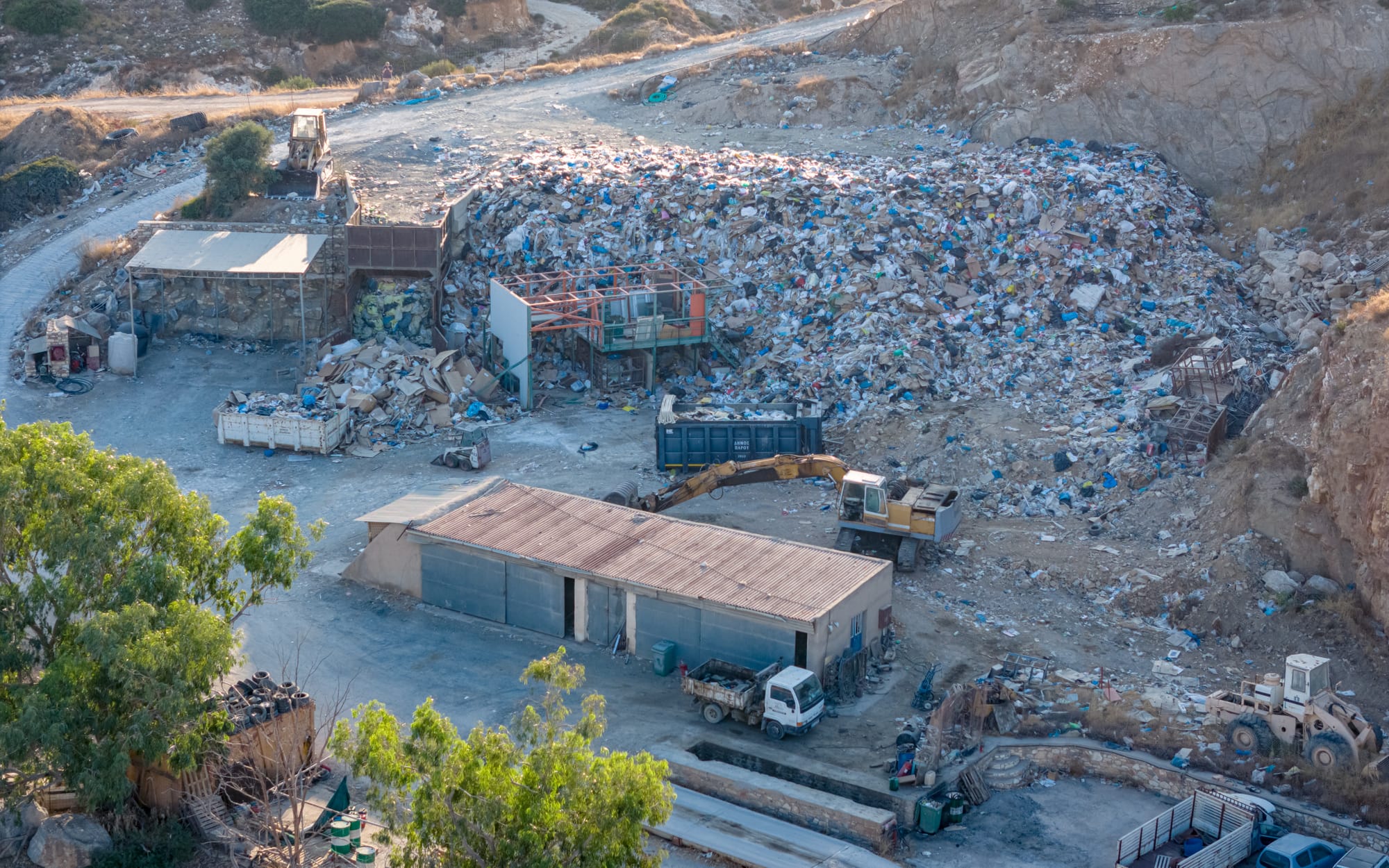
The former sorting centre at Agios Vlassis photographed in August 2026. It started up in 2015 and collected everything that was placed in blue bins until its closure on 30 April. Nothing has taken its place: the island’s recyclables are now stacked up here ready for collection by ship to Attica. ©_digitalparos
Six projects. Prevention, separation at the door, separate collection, composting, front-door drop-off, sorting. All of them were funded at some point in time since 2021. None are active now.
Sixty-three contracts
What was operating throughout was the hole in the ground, that is the landfill. From mid-2022 until at least 29 April 2026, it ran on successive direct contracts with WATT A.E., awarded without a public tender. Each lasted one or two months and was worth up to €30.000 before tax, the limit above which a public tender is compulsory.
Since 2022, according to a Kathimerini article, a total of 63 contracts regarding the site have been made by ΦΟΔΣΑ, 61 of them to a single invited bidder. All of them signed by Georgios Chatzimarkos as chairman of the board of ΦΟΔΣΑ, who also happens to be the elected Regional Governor of the South Aegean region which has a 40% stake in ΦΟΔΣΑ. Officially, each award was lawful. Splitting a continuous need into monthly contracts that stay below the threshold constitutes technical compliance. However, without competition, there are no discounts: while the tenders published by ΣΥΔΙΣΑΠΑ brought a discount ranging from 10 to 25%, these monthly awards yielded almost nothing.
It didn’t take a fortune teller to determine that the site was in trouble. In October 2022, Gamvroudis himself warned that the Paros dump was “a ticking time bomb ready to go off in our hands”. Later that year, the council warned that the retaining wall was “one step away” from collapse and that waste was blowing into the surrounding fields.
In April 2024 ΦΟΔΣΑ called the primary cell «το παλιό κορεσμένο κύτταρο», the old saturated cell, and quickly placed next to it «ένα μεταβατικό μικρό κύτταρο», a small “transitional cell” built «για να καλύψουμε τις τωρινές ανάγκες», to address immediate requirements. An interim solution. Another item on that list of milestones ΦΟΔΣΑ said it achieved in that same presentation was «Καθορισμός αυστηρού ελέγχου, κανόνων και πρωτοκόλλων διαδικασιών στις εγκαταστάσεις μας»: the establishment of strict controls, rules and process protocols at our facilities.
On 4 March 2026, the dry season was coming and the rubbish blown by the wind was piling up around the site. ΦΟΔΣΑ signed another direct award worth €25.000 for clearance, citing the risk of wildfires. A crew of 10 men, for 10 days. Less than five months later, the place was burning. The second phase of the landfill was contracted, on 22 June 2026, five weeks before the fire, for €7.114.893,56 by a contract between ΦΟΔΣΑ and the Region and WATT. This contract was put out to international open tender. There was one bid. The discount was 1%.
The contractor agreed that it would commit to six years of operation. These six years began when the contract was signed, not when the new cell is completed. This commitment to operate is split into phases. For the first six months (while it is building the new cell), it «αναλαμβάνει τη λειτουργία του υφιστάμενου ΧΥΤ και της υφιστάμενης ΕΕΣ». It will take on operations of the entire existing landfill and leachate treatment plant. Five weeks into this clause the site burned.
We reviewed that signed contract. It contains no references to “composting” on any of its 14 pages. Neither is there mention of “recycling”, “sorting centre”, “separate collection”, “green points”, “prevention”, or “reuse”. What we did see is that it pays for a new cell, waterproofing, leachate [5] collection and treatment, gas capture from buried waste, roads and equipment and that it obliges the island to continue landfill operations for a period of six years after signing.
It also includes a bulky-waste shredder. In its own guidance to local authorities, in the same April 2024 presentation, ΦΟΔΣΑ describes the purpose of a shredder: shred garden waste and branches, reduce the volume, compost the waste, return the compost to residents: three stages. On Paros the shredder made it into the waste management contract but the composting plant that was supposed to process the output from the shredder was never built. So the island was left with the first stage only, and the result goes into the landfill.
That machine was never optional. The site’s environmental permit [6], issued in September 2020 and valid until 2031, requires equipment inside the landfill to handle bulky items, prunings, green and woody waste and construction debris. It specifies two shredders: a primary one for bulky objects and branches, with a capacity of at least 25 tonnes an hour, and a secondary one behind it. Each is to be fitted with a water system for dust and noise, and for «τον μηδενισμό κινδύνου πυρκαγιάς», the elimination of any fire risk.
Nor was that machine unfunded. In its February 2026 plan for separate collection, ΦΟΔΣΑ lists two shredders for Paros in projects that had already been approved for funding: one shredder «εντός ΧΥΤ», inside the landfill, under project 5181144, approved in May 2023, and a towed branch shredder for the two Green Points, approved in June 2022. Neither reached the island.
The island has been without a shredder for six years. Since 29 July, the day after the fire, woody and bulky waste has also been barred from the landfill. ΦΟΔΣΑ says that’s because of the fire, and that the ban stays in place until the site is certified as restored and safe to reuse. The contractor, WATT, puts the missing shredder first: «δεν υπάρχει διαδικασία τεμαχισμού», there is no shredding process, and without one it will not take woody and bulky waste.
Paros has one licensed landfill that can accept the material, and nowhere else can. The equipment the permit requires to reduce the fire danger isn’t there. And so the piles have not disappeared and are mostly still in the streets. When the island finally demanded the equipment in September, it was given three separate delivery dates in three days.
What the new concession actually buys
The contract of the landfill lasts six years, but an even larger one is on the horizon to shape the future of waste management in the Cyclades. The plan for a recycling and recovery centre (January 2026) for Paros was made public just two months after the collapse of the tender of the sorting centre. It is part of a public-private partnership (ΣΔΙΤ) worth €194,92 million covering the islands of Syros, Mykonos and Paros and also includes a transfer station in Tinos. According to Kathimerini, soon Naxos will join too. It is the Region, not ΦΟΔΣΑ, that will run it, and the tender document says why: ΦΟΔΣΑ lacks the technical and administrative capacity, experience, and adequate staffing.
While the procurement remains in competitive dialogue (the negotiated phase of the tender), on 9 September 2026 the Region announced that it had entered the second phase. No location has been chosen on Paros, and no deadline has been established for binding offers. In any plausible scenario, the plant will not be operational for at least another six years.
The Paros plant is sized at 15.000 tonnes per year: 7.000 tonnes of residual mixed waste, 5.000 tonnes of pre-sorted recyclables, 3.000 tonnes of pre-sorted biowaste. That’s a design assumption that 47% of the island’s waste will still arrive mixed in 2053.
7.000 out of 15.000 tonnes. It’s a design assumption that 47% of the island’s waste will still be coming in mixed, in 2053. On Tilos, two hours away, it’s already below 7%.
The separate collection plan prepared by ΦΟΔΣΑ and approved by the ministry in March 2026 forecasts that in 2030, 7.597 of the 16.093 tonnes reaching the Paros facility will be mixed, 47% of the total, falling to 41% in 2035. Across the region, 13% of waste was recycled in 2024. The Paros facility is sized on the basis of the above 2030 projection, whereas the contract lasts until 2053. Why should a plant contracted until 2053 be sized as if source separation on Paros will stop improving in 2030?
Even if every other tonne were recycled, with no rejects on the sorting line, that caps recycling on Paros at 53% in 2030 and 59% in 2035. Greece has committed to 60% and 65%. The plan for Paros falls short from the start.
According to ΦΟΔΣΑ's projections, 47% of Paros's waste will still arrive mixed in 2030, and 41% in 2035. Even assuming that all the remaining waste was successfully recycled, and that there were no rejections along the sorting line, this would result in at most 53% and 59%. Greece committed to reaching 60% recycling by 2030 and 65% by 2035. These figures show that the plan for Paros falls short right from the start.
The amount of public funds will be up to €105,6 million for the construction of the plant, and the «πληρωμές διαθεσιμότητας», availability payments (indicatively calculated) to the operator are approximately €51,6 million. According to the tender, those payments are «συνδεδεμένες με την ποσότητα των απορριμμάτων που θα διαχειρίζεται», linked to the tonnes of waste the operator handles, and to criteria in the contract on availability and performance. The Region signs the agreement and is responsible for it until the plant opens. After that it passes to ΦΟΔΣΑ, which is funded by its member municipalities through charges set in its General Assembly (in which Paros has 3,8% of the vote).
So far that’s one revenue stream. The second one is among the partner’s entitlements, which includes «η εμπορική εκμετάλλευση … των παραγόμενων δευτερογενών προϊόντων (π.χ. ενέργεια, ανακυκλώσιμα υλικά, βιοαέριο, RDF, SRF κλπ)», the right to sell the plant’s output, including RDF and SRF [7], refuse-derived fuel, i.e. the leftover combustible part of the mixed waste that’s been dried, shredded and pelletised.
Under this plan, rubbish not produced is not weighed and produces no fees; rubbish better sorted at source leaves less residual rubbish to mix to make fuel. For every kg not thrown away an islander has taken the first revenue source away; for every kg well sorted, the second. And the €194,92 million is to pay for… only the plant, at the end. Collection, recycling centres, the Green Points, recycling, reuse, prevention etc. is still the responsibility of the municipality, which is constantly being denied funding for them.
This means that for the next 27 years, the company that deals with the island’s rubbish has a financial stake in there being plenty of it, and in as much of it as possible getting mixed up.
The current, second phase of the dialogue will settle whether the contract includes a minimum guaranteed tonnage for decades to come. It will also produce a payment budget that only the five bidders get to see, not the island. A telling example is the ΣΔΙΤ of Epirus, created in 2017, whose partnership agreement guarantees a minimum of 80.000 tonnes a year. When the regional authority there tried to fine the operator in 2019, the company, a subsidiary of GEK TERNA (ΓΕΚ ΤΕΡΝΑ), took the state to arbitration and won €3,1 million.
This type of provision helps protect the contractor’s income, but doesn’t incentivise waste minimisation. Were Paros to reduce its waste by a substantial amount, a minimum tonnage contract would force the island to pay for waste that was not produced in the first place.
The five consortia that were pre-selected are all major national construction groups: HELECTOR–THALIS, AVAX, METLEN–MESOGEOS, GEK TERNA and AKTOR–WATT (in Greek ΗΛΕΚΤΩΡ, ΑΒΑΞ, ΜΕΣΟΓΕΙΟΣ and ΑΚΤΩΡ). None of the consortia is an independent operator, and AKTOR–WATT has been pre-selected for all three of the Region’s waste partnerships. Meanwhile, AKTOR has committed to purchasing a 75% stake in the company that owns HELECTOR and Thalis for €300 million. That deal is expected to be completed at the beginning of 2027. If it closes before offers become binding, there will be two competing bids under the same corporate banner. The Region’s decision pre-selecting the five also records, without explanation, that a conflict of interest was reported to the competent authority.
AKTOR? Does that name ring a bell? In September the Wall Street Journal reported that the US ambassador to Greece had been touring the Balkans to push US gas projects that ran through AKTOR, often with an AKTOR lobbyist at her side.
Where the burnable part goes
Refuse-derived fuel (RDF) does not stay on the island: in Greece RDF is fed into cement kilns in place of petcoke or coal. In the case of Paros this scenario is already a present reality. Since July, Paros’s recyclables have been shipped to Koropi, to a sorting plant owned by Greece’s biggest cement company. In 2023 WATT sold its waste sorting business on the Greek mainland to the multinational Holcim group. Since April 2025 that business has been part of Geocycle Hellas, the alternative fuels division of Heracles (ΑΓΕΤ Ηρακλής) – Greece’s largest cement producer, wholly owned by Holcim. Geocycle’s own published data put its use of solid recovered fuel from its Greek business at 20.000 tonnes a year, and it aims to replace 90% of its fossil fuels by 2028.
Using waste-derived fuel in place of coal and petcoke is a perfectly legitimate goal for a cement works, both for the climate and for avoiding landfill. The issue is where the feedstock comes from.
In the waste hierarchy, refuse-derived fuel is a form of recovery that sits above landfill disposal but below recycling, reuse and prevention. The combustible content should only be what’s actually left over after the recyclables and organics are removed. But when a facility is built expecting that 47% of the incoming waste will be unsorted, recovery stops being a safety net and becomes a specification.
The same 27-year contract covers both the sale of the fuel and the mixed waste it is made from, and not a euro of the €194,92 million goes towards reducing that waste. All of this is lawful and in the open. It also rewards mixed waste.
What marks out Tilos, a small island in the Dodecanese, as a success story is the share. Its rubbish that can’t be recycled or composted is also turned into secondary fuel and shipped to Athens for the cement industry, but that’s less than 7% of what residents produce.
What Tilos demonstrates
Gamvroudis showed his Paros audience slide 18.
«Just Go Zero Tilos: Το πρώτο νησί μηδενικών αποβλήτων στον κόσμο βρίσκεται στην Περιφέρεια Νοτίου Αιγαίου.» (“Just Go Zero Tilos: The world’s first zero-waste island is located in the Region of South Aegean.”) And on the same slide: «Συμμετέχοντας σε καινοτόμες δράσεις όπως το πρόγραμμα “Just Go Zero Tilos”, κάνουμε πράξη τον στόχο για νησιά με μηδενικά απόβλητα.» (“By taking part in innovative initiatives such as the ‘Just Go Zero Tilos’ programme, we are putting the goal of zero-waste islands into practice.”) Within one sentence the verb travels from «Συμμετέχοντας» (participating in) to «κάνουμε πράξη τον στόχο» (we make it happen).
Since December 2021, Tilos hasn’t buried any waste. More than 93% of the waste produced is composted or recycled, and the old landfill is a circular economy centre. In July 2023 it became the first island in the world to earn European Zero Waste Cities certification, and in November 2024 it won the European Commission’s Grand Jury Prize. There are no street bins anywhere on Tilos. It collects waste from the households’ doorstep three times a week.
That’s a fact, but it was not the Region’s accomplishment. It was Polygreen, a private company, that designed, funded and operated the scheme and invested about €1,7 million of its own capital into the island’s infrastructure long before there was a public agreement. ΦΟΔΣΑ’s formal involvement came later: in April 2024 the Region announced that ΦΟΔΣΑ «το αγκάλιασε», had embraced it. Tilos had been producing no landfill waste for more than two years at that point and had held certification for nine months.
Tilos got there by removing the street bins and switching to door-to-door collection at set times, so households, restaurants and hotels all knew when the van would arrive. Three waste streams were separated. Residents saw the results of their efforts. The mayor says that she had her team talk to schoolchildren first, to encourage the children to convince their parents.
On Tilos, collection did the work. Collection is nowhere in the €194,92 million project that will determine waste management on Paros, Syros, Mykonos and Tinos, with Naxos to follow.
And the price for a system like this on Tilos? Around €3.000 a tonne. Tilos is a much smaller island, and no-one should argue that its model carries over to Paros unchanged. But what Tilos achieved does tell us one thing: the 47% unsorted material that the Paros facility is based on is not an island attribute. Or a Greek one. Or a tourist one. It’s a collection-system feature.
Antiparos is closer to home. It’s a much smaller island, so all the same caveats hold, but it sends its waste to the same landfill and belongs to the same ΦΟΔΣΑ, and no private company built its system for it. The toughest challenge it faces, says Artemis Triantafyllos, who spoke to ΕΡΤ as deputy mayor and has since become mayor of Antiparos, is the 10.000 to 15.000 day-trippers it takes from Paros in high season. (At its busiest, Paros hosts up to some 72.600 people at a time.) Initially, the municipality used makeshift chicken wire bins for plastic bottles.
After a pilot in September 2023, the municipality has separated its waste at source since 2024, collecting it from each home. A small vehicle collects glass, PET and aluminium from the shops and brings it to a transfer station at the municipal depot. Bins have been removed from the street as much as possible, leaving no place for a passing visitor to leave a bag on the pavement. Leaving aside the vehicles, machinery and compactor containers, he puts the cost of the whole contract at about €20.000.
This is most evident in the reduction of glass, paper from supermarkets and PET reaching the landfill on Paros. When asked whether it had solved the island’s rubbish problem, Triantafyllos replied: «Στο 100% όχι, αλλά έχουμε κάνει σημαντικά βήματα προόδου.» Not a hundred per cent, but we have made significant steps forward.
It’s the same landfill, the same governing body. So the difference is at the door.
Tilos shows up when the Region celebrates its achievements. However, neither did Tilos appear in the Region’s announcement of that second phase, nor in ΦΟΔΣΑ’s public defence after the fire. The Region’s showcase focus went to Rhodes: the Just Go Zero app rolled out to Rhodes in March 2024, and to Kalymnos in September 2025; and slide 17 of Gamvroudis’s presentation was “Rhodes 2030”, the Region’s collaboration with TUI to make the island an all-in-one destination.
What Paros got was a landfill extension and an order for a shredder.
A plan for Paros does exist, written by a man nobody asked. Dirk Cortvriend is a Belgian civil engineer who spent his working life in the waste industry and now lives on the island. He founded ΚΛΕΑ, an initiative for environmental accountability on Paros. Back in September, he sent Mayor Bizas 23 slides titled, «Η Πάρος πρέπει να ανακτήσει τον έλεγχο των αποβλήτων της» (“Paros must regain control of its waste”).
The proposal includes a waste-sorting centre on the western part of the former airport, composting for food and garden waste, drop-off points around the island, card-access bins to penalise fly-tipping, and tariffs that charge households for the rubbish they actually produce. That last one is exactly what ΦΟΔΣΑ’s unsigned 2021 draft contract specified.
Policy-wise, it has one demand, the creation of a waste utility to reflect the water utility, which would include the Green Points as the face of it. He says that it can probably be done in six months (that’s optimistic), but it’s still just an advocacy document, not an adopted plan. Still, this is the only paper that asks “what can this island do for itself?” It exists because someone sat down and put it on paper.
In the meantime, in September
While all of this is set out in project briefs and 27-year plans, the island has been living since 29 July with a landfill that turns away bulky and woody waste.
Then, on 4 September, the cultural association Archilochos, along with 11 other groups, wrote (under a protocol number) to the General Director of ΦΟΔΣΑ, Christos Gamvroudis (the same man who gave the April 2024 presentation), requesting a space for collection inside the dump and a schedule, noting the «διάσπαρτων ανεξέλεγκτων σημείων απόθεσης σε ολόκληρο το νησί» (“uncontrolled scattered points of dumping throughout the island”). No response yet, a month down the line.
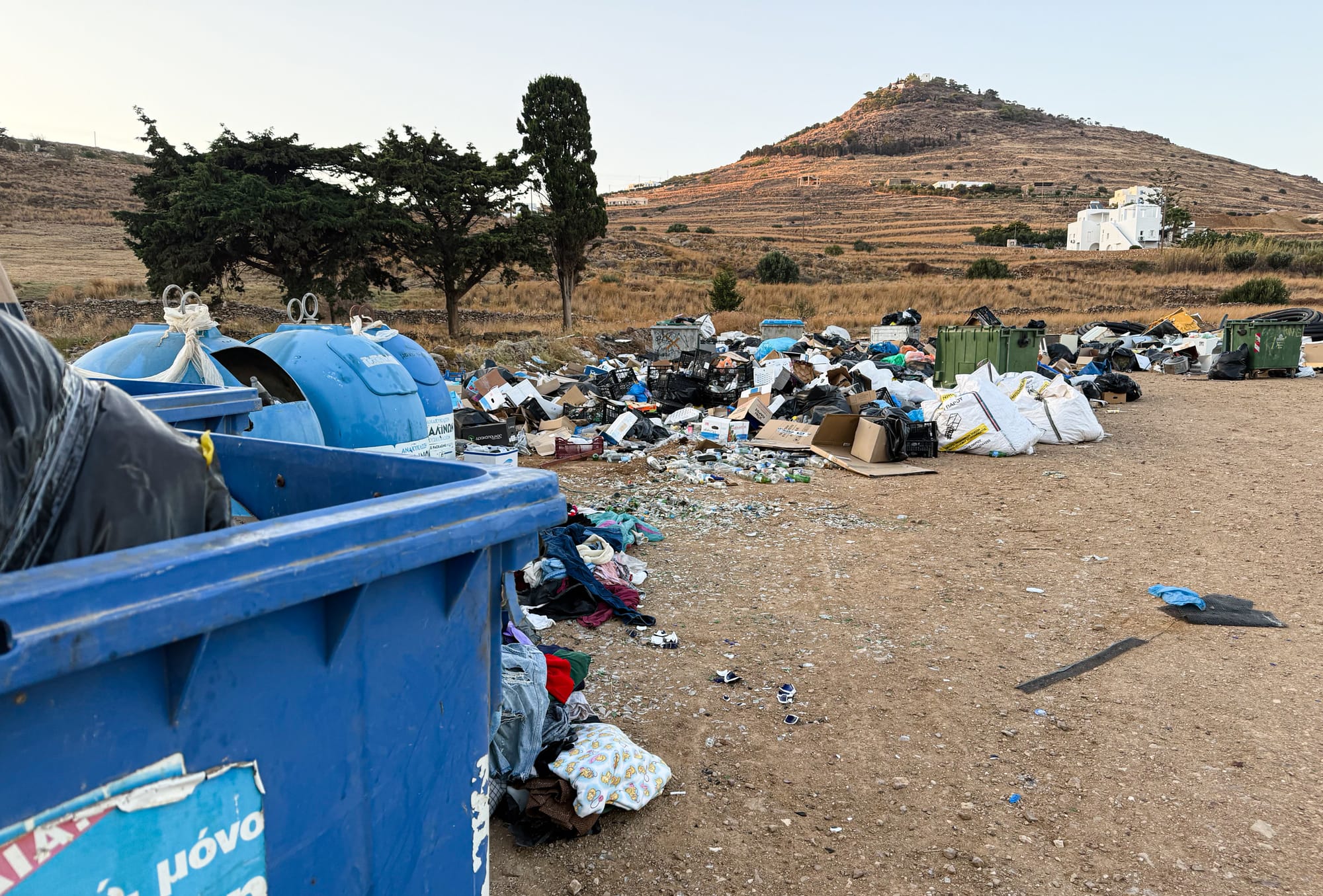
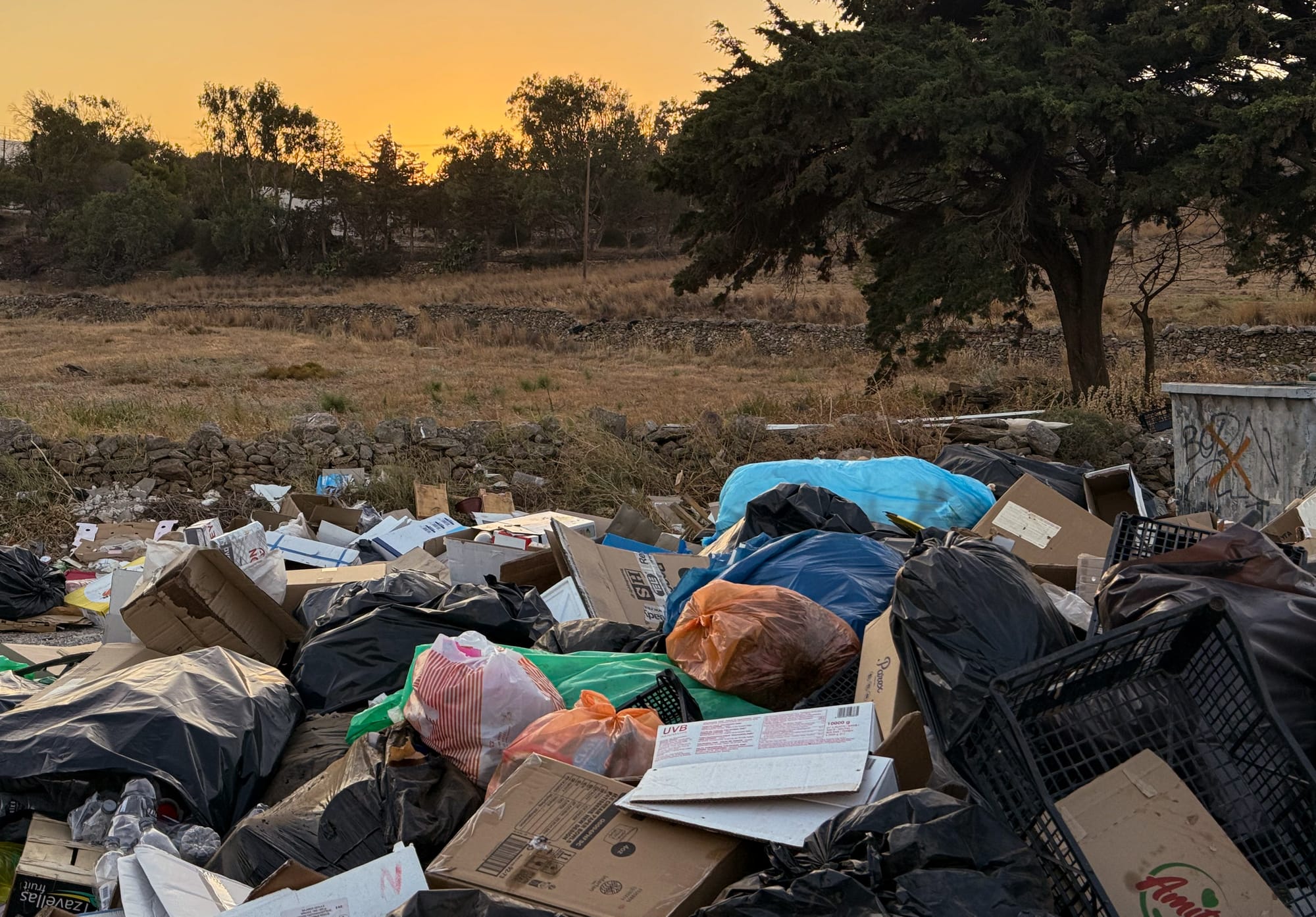
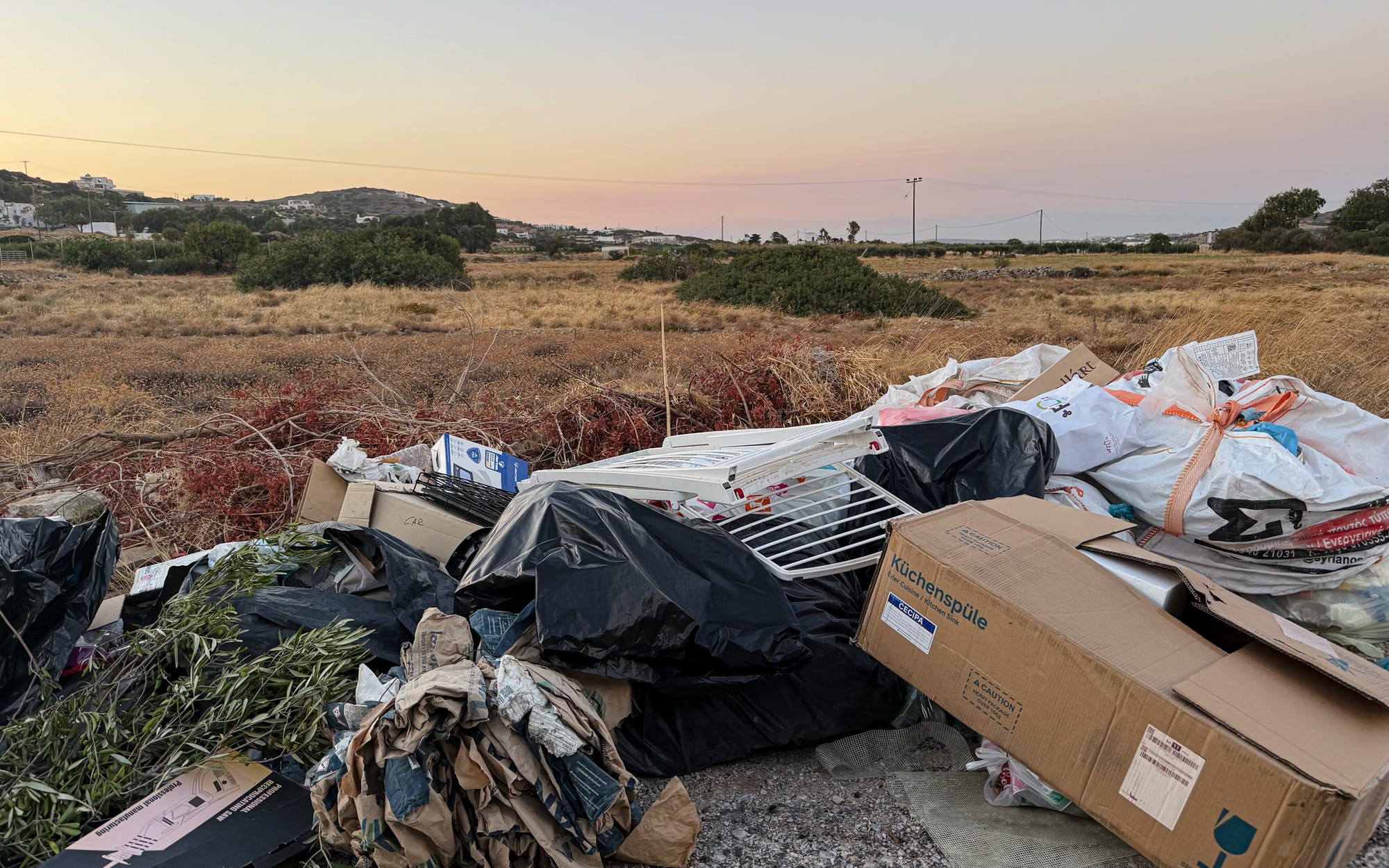
Around the island, bins full of waste, including green waste, 1 August 2026. The landfill closed its doors to such material three days before, and it’s the only facility on Paros licensed to accept it. It remains closed two months later. ©_digitalparos
The dispute eventually boiled down to one piece of equipment: a shredder that the landfill’s permit has required since 2020 and that was funded as early as 2022. The council voted unanimously on 10 September to serve legal notice on ΦΟΔΣΑ and WATT. On the very same day ΦΟΔΣΑ announced the “immediate procurement” of the shredder. The deputy mayor for cleanliness, reading the contract’s tender budget, put delivery at around Christmas. And on 13 September Katris (WATT) promised the end of September or the beginning of October: «Δεσμευόμαστε γι’ αυτό» (“we commit to that”). By 20 September the obligation had become «το έτος 2027» (“the year 2027”). By then, Katris said, the equipment was ΦΟΔΣΑ’s responsibility, and ΦΟΔΣΑ had decided on its own to lease one. So far one piece of equipment has four dates. If there is a definite date, it is included in documents that unfortunately are not public.
At the same council session on 10 September, the mayor learned that ΦΟΔΣΑ’s General Assembly was meeting that day on Kalymnos, with Paros on its agenda. The municipality had been neither told about the meeting nor invited. «Δεν έχουμε λάβει πρόσκληση. Ούτε φάκελο, ούτε γραπτό, ούτε email. Δημοσιογραφικά το έμαθα.» (“We haven’t received an invitation. Neither a letter, nor a written notice, nor an email. I found out about it from the press.”), the mayor said.
ΦΟΔΣΑ replied with a statement headed «Το ψέμα έχει κοντά πόδια» (“a lie has short legs”), and, as proof, a photo of an email sent to “undisclosed recipients” with a black rectangle covering the recipient line. The municipality responded that a technical inspection of its mail server showed no record of the email ever arriving; called on ΦΟΔΣΑ to apologise publicly; and pointed out that the Regional Governor had not contacted the mayor once since the fire. And «Τα ηλεκτρονικά μηνύματα αφήνουν ίχνη.» (“Emails leave traces.”)
Then, on 13 September, Foni tis Parou filmed a video at the landfill. Katris said the fire was still burning inside the covered waste piles and that such piles can burn for years. Standing beside him was Vazaios Petropoulos, who had been appointed by Chatzimarkos as Deputy Governor of the Region for Paros and Antiparos in 2023, saying he hoped the Parians would offer their apology, «εντός εισαγωγικών» (“in quotation marks”), to the Region.
Describing what 2027 would bring, Katris got as far as “a completely different management and…” before stopping. Petropoulos supplied the missing word: “…Image.” Katris said it back. “Image.”
On 15 September, Haris Giourtzidis, the deputy mayor for civil protection, asked ΦΟΔΣΑ 15 questions regarding its compliance with the environmental permit: Where is the water tanker? What about the broken fence? How did the leachate get to the stream? And the shredder? The permit has required one for six years to remove the possibility of fire. One of his questions does not need a technical answer: the cell was constructed in 2008 with a 10-year lifespan. It’s now 2026.
In his statement on 20 September to Parianos Typos, Katris gave WATT’s version of events, saying that ΦΟΔΣΑ is the sole manager of the landfill and that WATT is just the contractor.
Katris says that the fire broke out where the municipality left bulky waste, near the ground on which according to the permit there would be a facility for their treatment (a facility that has never been built). However, according to the contract he signed on 22 June, Katris has taken over the operation of the existing landfill for the first six months. So whoever took the material there (a question now before the court), this ground was the contractor's responsibility under the June contract, and it is where the permit places the bulky-waste unit that was never built
He gives three reasons for keeping bulky and woody waste out: there’s no shredding process; there’s no receiving area; «δεν διασφαλίζεται επάρκεια στη λεκάνη ταφής» (“sufficient capacity in the burial basin is not assured”). The last point is the clincher: a new landfill cell needs to be built (which means that acquiring a shredder might not be enough to let it back in). Katris shared numbers in September showing only three to four months’ worth of disposal capacity in the basins. Plans to build the replacement landfill cell were complicated by the fire: the ground where the burned material lies cannot be used. The revised plan includes extensive reinforced-concrete construction to get «τη μέγιστη δυνατή χωρητικότητα υπό τις νέες συνθήκες» (“the greatest capacity the new conditions allow”).
On the blue bin, he arrives at what could be this article’s own argument: diverting it to Attica «δεν συνδέεται με ανυπέρβλητη αδυναμία διαχείρισης, αλλά είναι ζήτημα δαπάνης» – it is not an insurmountable management problem, it is a question of expenditure.
This is where the island stands at the beginning of October 2026. The landfill is under an emergency declaration and still burning underneath. It is closed to bulky and woody waste, and the piles are mounting in the open. There is no sorting centre, and recyclables go to Attica at a higher cost than processing them here. The composting plant has no tender, the Green Points have no money, and the shredder has four delivery dates and no delivery.
On 13 September Kostas Argouzis, a former mayor of Paros, asked the only question that called for a date: the landfill had refused this waste for more than 30 days and it was a risk to public health, so when would it take it back? There were no answers. The landfill still turns that waste away.
What the island is asking for
On 16 August, associations and citizens’ groups from across the island stood outside the landfill to ask that bulky and woody waste be let in again. On Wednesday 23 September they gathered outside the Επαρχείο, the Region’s office on the island, with the same demands. Two days earlier ΦΟΔΣΑ had answered them – not the demands, but the associations themselves, speaking of «εργαλειοποίηση των συλλόγων», their instrumentalisation by the mayor’s associates, and asking: «Πότε οι σύλλογοι έθεσαν ερωτήματα στον ΦοΔΣΑ Νοτίου Αιγαίου και αυτά δεν απαντήθηκαν;» When did the associations put questions to ΦΟΔΣΑ that went unanswered? Archilochos had by then been waiting 17 days for an answer.
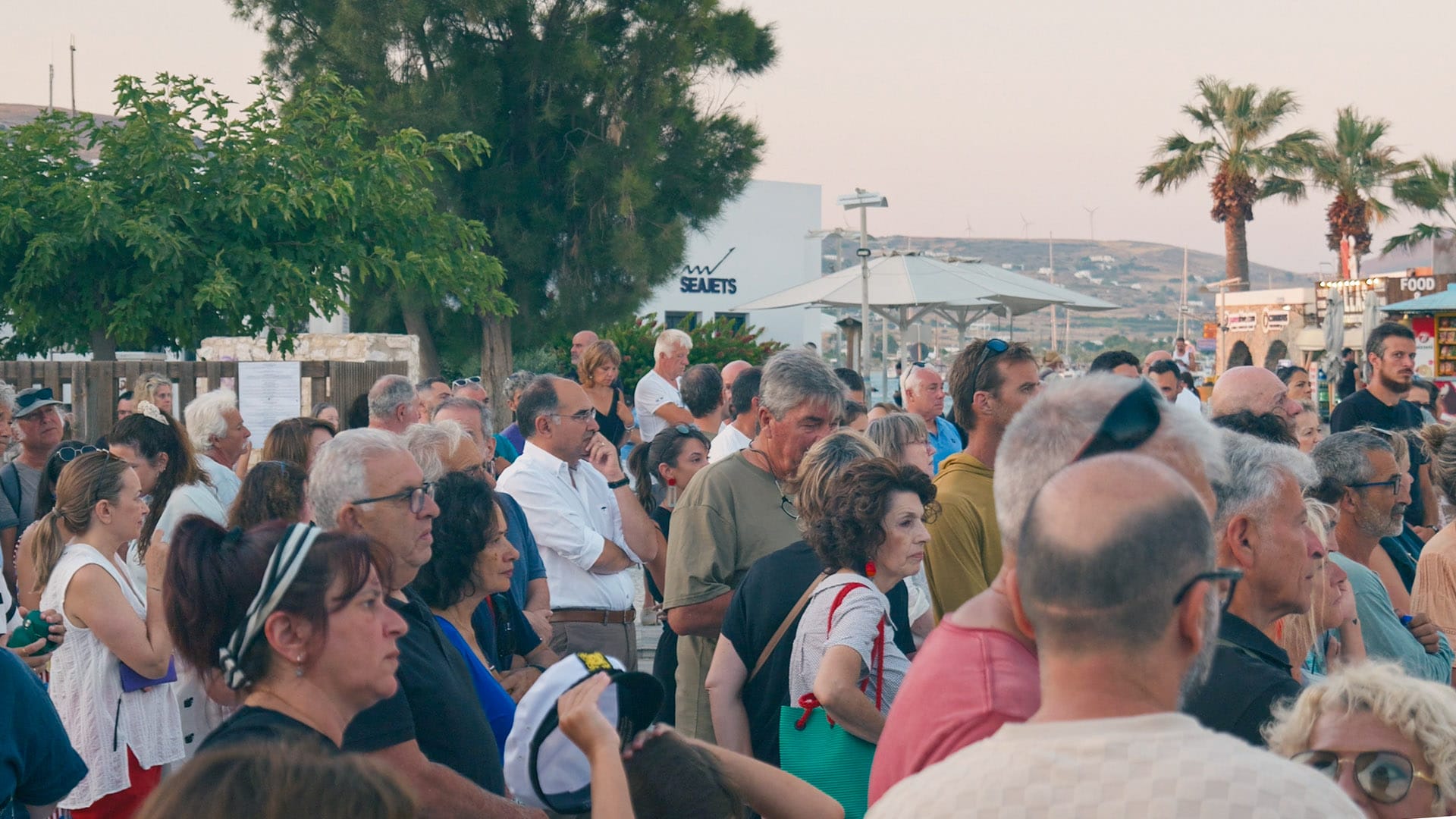
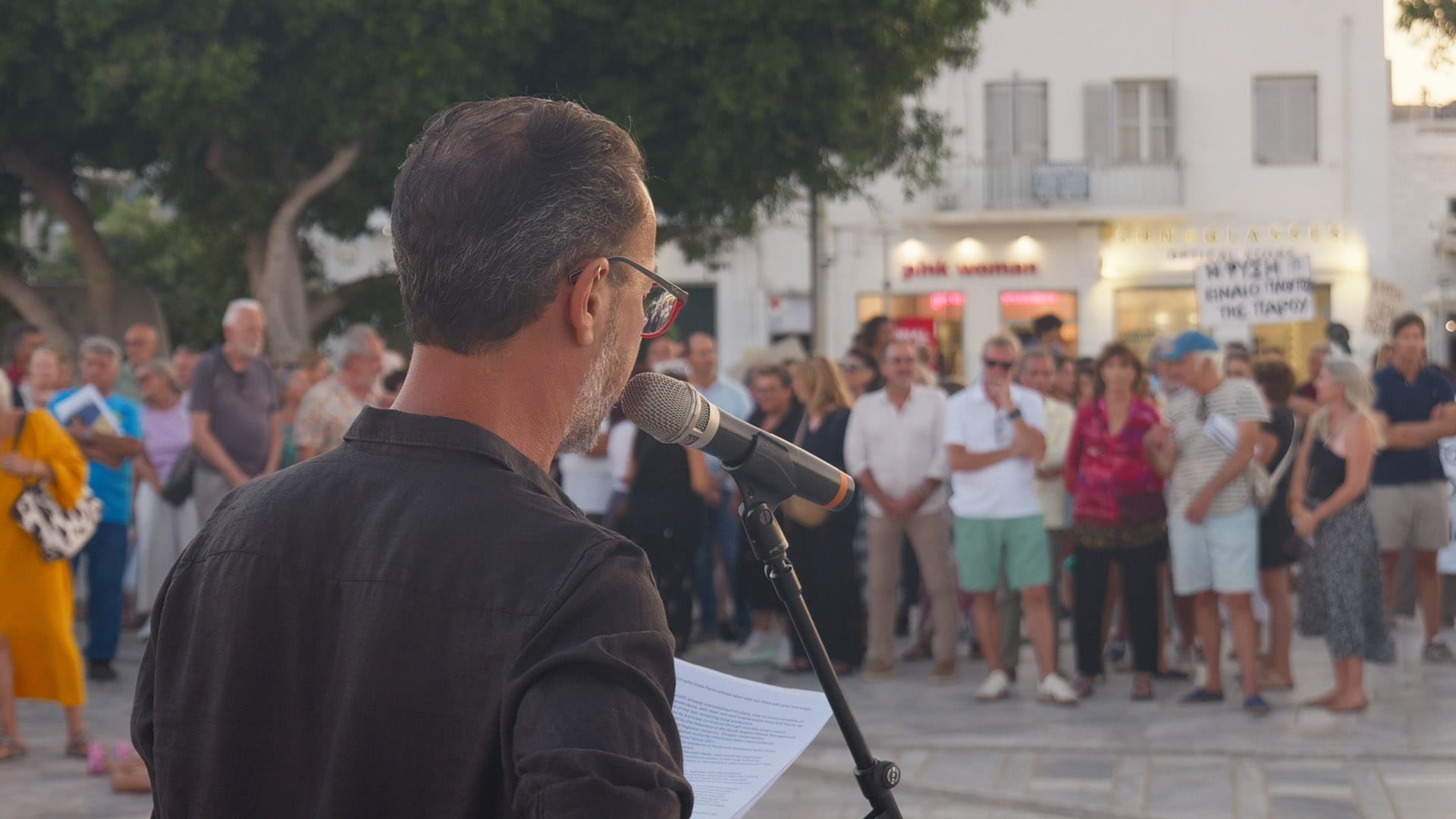
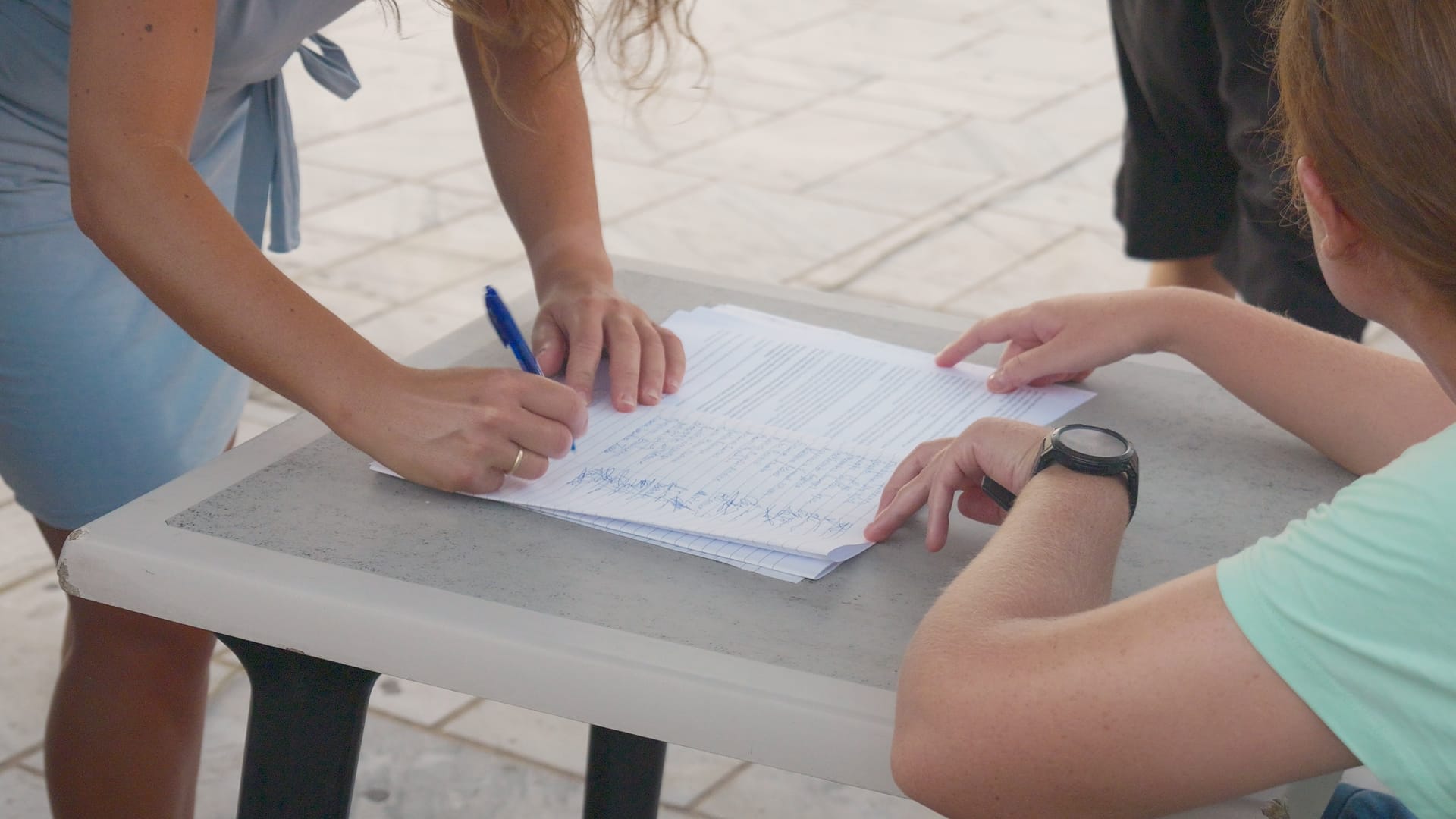
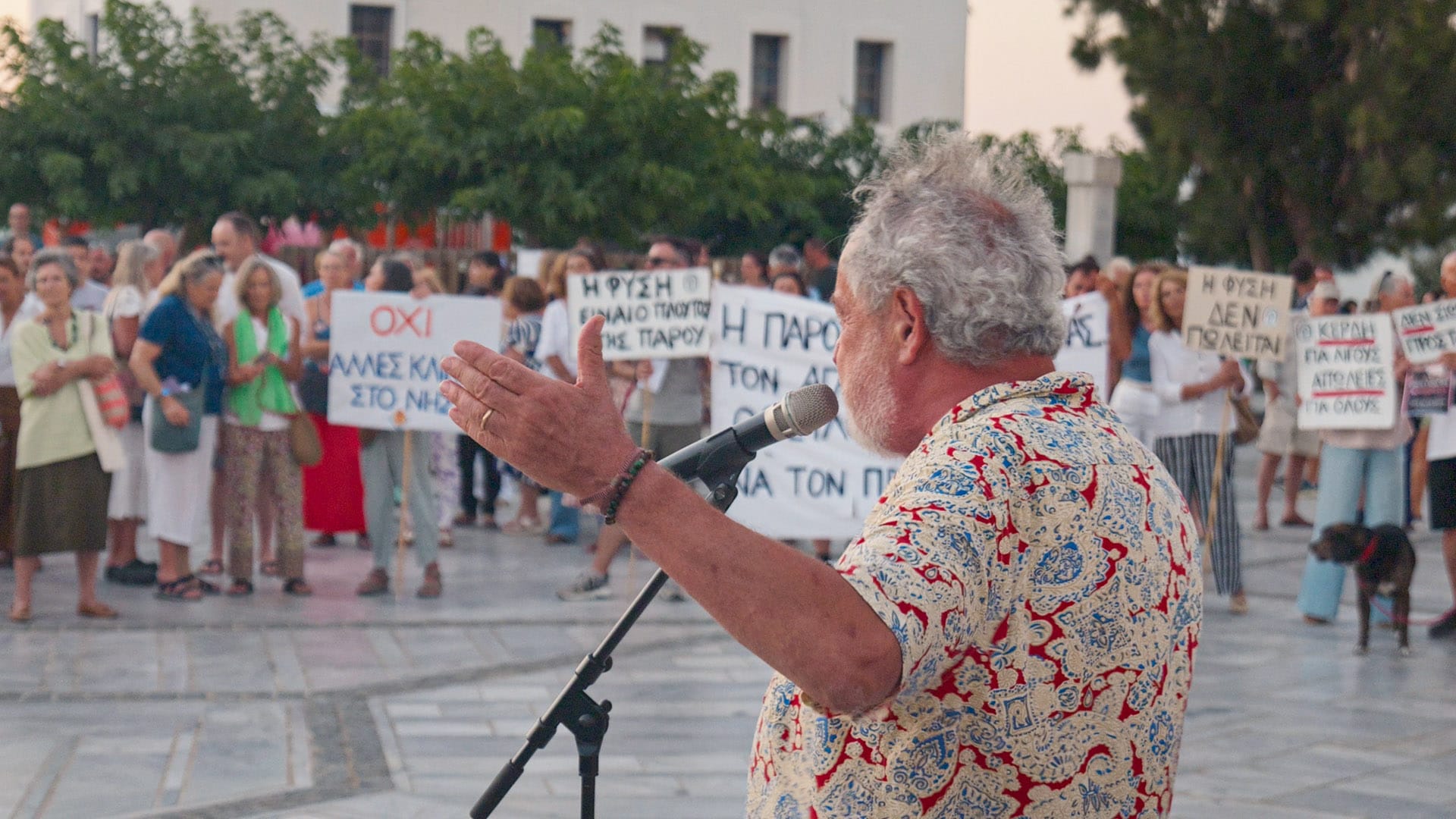
Mando Mavrogenous square, Parikia, Saturday 8 August 2026, 11 days after the fire. The cultural associations, unions and civic bodies of Paros organised the rally as the start of a long battle to save the island. In their statement they write that the landfill has been overflowing for years, run by a private contractor on month-to-month contracts since 2022, each signed off by the president of ΦΟΔΣΑ, who is also the Regional Governor, and that the cost of running it has nearly quadrupled since ΦΟΔΣΑ took over in 2021. They call for modern waste and recycling facilities, rehabilitation of the scorched land, help for the people who lost their livelihood, and a Paros that isn’t marketed like a postcard but inhabited like a home. The resolution ends on one line, in capitals: «ΖΗΤΑΜΕ ΠΙΣΩ ΤΗΝ ΑΥΤΟΔΙΟΙΚΗΣΗ ΜΑΣ». We want our self-government back. ©_digitalparos
There’s one more line in that resolution of the 8 August rally that no institution in this story has chosen to put on paper: «εξακολουθεί να αντιμετωπίζεται ως πεδίο επενδύσεων, εργολαβιών και ανταποδοτικότητας και όχι πρωτίστως ως ζήτημα προστασίας του περιβάλλοντος και ποιότητας ζωής» (“Waste management continues to be treated as a field for investment, contracts and profitability, and not first of all as a matter of environmental protection and quality of life”). What they ask for is straightforward: restore the landfill on a timetable, protect it against fire, provide a permanent licensed site for bulky and green waste and a permanent facility for recycling, and fund it from the state without new charges on Parians, all with dates. For each of these requests there is a document: a permit condition, a tender that was voided, a project that lost its funding, a promise with a deadline that came and went.
On 30 September representatives of 20 associations and bodies concerned about waste management issues on Paros met and took decisions. Among these is a request for a meeting with the Regional Governor and the mayor to take place in the Paros town hall in October and for a day of talks to be organised with guests who have solved similar problems elsewhere. Their letter, which has yet to be finalised, points out that at a meeting with Petropoulos they were promised the shredder by the end of October. So before September was out, the shredder had a fifth date.
Six demands, before the 27-year concession is signed
- Publish the payment mechanism before offers become binding: how the operator’s payments depend on the tonnage it handles, whether Paros must guarantee a minimum amount of waste, and what the island would pay if it managed to produce less. Without that, whoever processes the waste earns more the more waste there is, and has no reason to help reduce it.
- Explain why a plant designed in 2026 assumes that 47% of the island’s waste will still be unsorted in 2053, and what would have to change for that share to fall.
- Set a public target, with dates, for how much of Paros’s waste will be recycled or composted. Waste contracts need to be based on transparent public objectives regarding the reduction of waste produced and increase in recycling and composting in Paros, with specific percentages and deadlines.
- See to the immediate completion of Green Points and provide deadlines for the development of sorting infrastructures in Paros, which would also facilitate household sorting.
- Make a household that sorts pay less than one that does not (pay-as-you-throw), a principle that is included in the draft municipal contract of ΦΟΔΣΑ under the title «Σύστημα Πληρώνω Όσο Πετάω».
- Call on the National Transparency Authority to conduct an independent administrative inquiry, alongside the criminal case, into how this waste site was permitted, contracted and supervised.
None of this is exotic. The last demand is ordinary accountability. The fifth is already in ΦΟΔΣΑ’s own records. And the household-level identification that makes any of it work runs on Tilos, a tiny fraction of our size. It was meant to be deployed at each recycling station on every other island in the area, under the programme Paros was not part of.
The responsibility for the 28 July fire is for the courts, and the courts will take years. But the issue that cannot wait to be decided is the one that is being settled at present, in a negotiation to which Paros is not party, concerning a contract that will outlive every one of the current debaters: is this island going to be treated as a source of waste, to be minimised? Or as a fuel source, with people living on top?
Notes
Quotations from Greek sources are given in the original, followed by our translation.
- [1] EOAN: The Hellenic Recycling Organisation (Ε.Ο.ΑΝ.) is the national body for recycling, supervised by the Ministry of Environment and Energy. It licenses and audits the Alternative Management Systems (ΣΣΕΔ) for packaging, waste electrical and electronic equipment, batteries, tyres, waste oils, end-of-life vehicles and construction and demolition waste, keeps the National Producers' Register (ΕΜΠΑ) and monitors progress towards the recycling targets. For municipalities, it is the counterpart for funding separate-collection infrastructure and for contracts with the ΣΣΕΔ.
- [2] ΜΕΒΑ: Μονάδα Επεξεργασίας Βιοαποβλήτων, a bio-waste treatment unit. It is a composting plant designed to take separately collected food and garden waste and turn it into compost instead of having it buried. The Paros unit is planned for 1.500 tonnes a year. It already had its environmental permit in June 2021, when its final design study was described as being at its final stage, and it belongs to the same EU-funded programme as the landfill works from that application. As of October 2026 it still exists only as studies.
- [3] ΕΑΔΗΣΥ: The Single Public Procurement Authority (ΕΑΔΗΣΥ) is an independent authority set up under Law 4912/2022 by merging ΕΑΑΔΗΣΥ and the Authority for the Examination of Preliminary Appeals (ΑΕΠΠ). It has a dual role: on the one hand regulatory and supervisory — it gives opinions on draft legislation, issues guidelines and standard tender documents and audits contracting authorities; on the other quasi-judicial, as it hears preliminary appeals against contracting authorities' decisions at the stage before a contract is concluded. For a municipality, it is the body whose standards govern its tenders and before which the related decisions are challenged.
- [4] ΕΕΑΑ: The main collective scheme through which companies that put packaging on the Greek market meet their legal obligation to pay for its recycling, and the organisation behind the blue bins. The agreement under which Paros's recyclables have been sent to Attica since July 2026 is with ΕΕΑΑ. According to the ministry, once the new deposit-return scheme is approved, ΕΕΑΑ will submit a new operational plan, under which it will also take over the collection of recyclables from the municipalities.
- [5] Leachate: The liquid that drains out of buried rubbish — rainwater and moisture that has passed through the waste and carried off whatever dissolves along the way. A modern landfill lays a waterproof liner under each cell, collects the leachate in pipes and stores it in a tank before treatment, so that it does not reach the groundwater or the sea. The 2026 contract pays for extending the collection network and upgrading the treatment unit for the new cell.
- [6] ΑΕΠΟ: The Environmental Terms Approval Decision (ΑΕΠΟ) is the administrative act that grants environmental permission to a category A project or activity under Law 4014/2011, after an Environmental Impact Study (ΜΠΕ) has been prepared and assessed and a consultation held. It is issued by the Ministry of Environment and Energy (subcategory A1) or by the Decentralised Administration or Region (A2), sets binding operating conditions and has a fixed term of validity, which can be renewed or amended. Category B projects do not require an ΑΕΠΟ and fall instead under Standard Environmental Commitments (ΠΠΔ).
- [7] RDF and SRF: secondary fuels. Both are produced from the burnable fraction of mixed waste — plastics, paper, cardboard, textiles, wood — after the recyclables and organics have been removed. The material is shredded, dried and compressed into pellets or bales, and burned in industrial kilns, most commonly cement kilns, in place of coal or petcoke. SRF is the higher-specification version. Producing them is generally preferable to burying the same material. They are also a commodity with a buyer, and that is what matters here: the more mixed waste reaches a plant, the more fuel there is to sell.
Sources
The primary documents behind this article are public. Most of them are in Greek.
-
ΦΟΔΣΑ Νοτίου Αιγαίου – presentation to Paros by General Director Dr Christos Gamvroudis, 14 April 2024.
The 29 slides and a 16-minute recording, including the €40.242.091,43 separate-collection programme marked (εκτός Πάρου & Νάξου), the spoken explanation of that bracket, the 16 regional projects, and the ΜΕΒΑ listed as «Προς Δημοπράτηση».
get the presentation - watch the presentation with English subtitles -
The signed works contract for the Paros landfill, 22 June 2026.
«ΚΑΤΑΣΚΕΥΗ ΤΗΣ Β΄ ΦΑΣΗΣ ΚΑΙ ΑΝΑΒΑΘΜΙΣΗ ΤΗΣ ΕΓΚΑΤΑΣΤΑΣΗΣ ΕΠΕΞΕΡΓΑΣΙΑΣ ΣΤΡΑΓΓΙΣΜΑΤΩΝ (ΕΕΣ) ΤΟΥ ΧΥΤ ΠΑΡΟΥ», €7.114.893,56 excluding VAT, between ΦΟΔΣΑ Νοτίου Αιγαίου, the Region of the South Aegean and WATT A.E. Fourteen pages, signed in Rhodes.
ΑΔΑ 9ΝΜΝ7ΛΞ-8Ο0 -
The Region of the South Aegean ΣΔΙΤ for Syros, Paros, Mykonos and Tinos, January 2026.
€194,92 million; the 15.000 t/yr sizing for Paros; the availability payments «συνδεδεμένες με την ποσότητα των απορριμμάτων»; and the right to «εμπορική εκμετάλλευση» of RDF and SRF.
ΑΔΑ ΨΥΠΓ7ΛΞ-ΖΨ3 -
Interview with Thanassis Katris, Managing Director of WATT A.E. — Παριανός Τύπος, 20 September 2026.
WATT's fullest public account to date: the ΦΟΔΣΑ/contractor division of responsibility, the fire's location on ground where the municipality deposited bulky waste, the three grounds for the bulky-waste ban, the 2027 date for the shredding obligation, the environmental permit's sludge clause quoted verbatim, and the closure of the sorting centre.
parianostypos.gr -
ΕΡΤ, «Φάσμα», 22 September 2026.
Television report on waste on Paros and Antiparos, including Mayor Costas Bizas on the cost of shipping recyclables and its passing on to municipal charges, and an interview with Artemis Triantafyllos, Deputy Mayor for Administrative Affairs of Antiparos, on the island's door-to-door separation at source.
YouTube -
Dirk Cortvriend / ΚΛΕΑ, «Paros must regain control of its waste», September 2026.
Twenty-three slides sent to Mayor Costas Bizas, with eight backing memos. Proposes a sorting centre on the western zone of the old airport, composting, drop-off points, card-access bins, pay-as-you-throw tariffs and a dedicated municipal waste utility that would take over the Green Points.
download PDF -
ΦΟΔΣΑ Νοτίου Αιγαίου board, 24 March 2021, item 34: approval of the draft programmatic agreement with the Municipality of Paros for «Δράσεις ανάπτυξης υποδομών χωριστής συλλογής ανακυκλώσιμων στους δήμους της Περιφέρειας Νοτίου Αιγαίου».
Contains the full unsigned draft: the 771 user-identified recycling points, the ten-year term, the free transfer of equipment, and «Σύστημα Πληρώνω Όσο Πετάω».
ΑΔΑ 9Θ9646ΜΜ4Ο-ΙΕΑ -
Δήμος Πάρου, Οικονομική Επιτροπή, απόφαση 199/2021, 23 June 2021.
The unanimous decision, chaired by Markos Kovaios, to apply for the transfer station (~€1.680.000), the Paros–Antiparos biowaste collection network (€637.454,61) and the ΜΕΒΑ land (€165.000), recording that ΦΟΔΣΑ would submit the landfill extension and the composting plant in the same act.
ΑΔΑ 6Τ3ΕΩΞΓ-ΒΑΞ -
Declaratory act 32559/5-12-2023, Αποκεντρωμένη Διοίκηση Αιγαίου, granting ΦΟΔΣΑ the free use of the 13.766 m² parcel at «Άγιος Χαράλαμπος» that Paros had bought with its own funds for the ΜΕΒΑ.
Published ΦΕΚ Β΄ 7015/13-12-2023.
ΑΔΑ Ψ6Ξ9ΟΡ1Ι-Λ2Γ -
Δήμος Πάρου, δημοτικό συμβούλιο, απόφαση 241/2023, 15 December 2023.
Taken off-agenda as urgent; the council votes unanimously to have the municipality's lawyer examine an appeal to the Council of State against that act.
ΑΔΑ Ψ4ΕΔΩΞΓ-ΙΣΧ -
ΕΑΔΗΣΥ, 7th Chamber, decision 1509, 1510/2025, 26 September 2025.
The ruling that disqualified both bidders for the island's recycling contract. Twenty-six pages; party names are redacted in the published text.
eadhsy.gr -
The landfill's environmental permit (ΑΕΠΟ), 9 September 2020, valid to 2031.
Αποκεντρωμένη Διοίκηση Αιγαίου, αρ. πρωτ. 39443. Sets out what the site is licensed to accept and under what conditions — including the on-site equipment required for bulky, woody and green waste: «Εξοπλισμός για τον τεμαχισμό ξυλωδών, ογκωδών αποβλήτων», a shredder of at least 25 t/h with a water system for «τον μηδενισμό κινδύνου πυρκαγιάς», and a secondary shredder of 40 m³/h.
ΑΔΑ Ω2ΧΒΟΡ1Ι-005 -
ΦΟΔΣΑ Νοτίου Αιγαίου, Μελέτη οργάνωσης και λειτουργίας του Ολιστικού Συστήματος Χωριστής Συλλογής ΑΣΑ (ΟΣΧΣ), February 2026.
By Enviroplan A.E., 174 pages, reference year 2024. The existing recycling points, Green Points and shredders on each island, including the three recycling points on Antiparos and the two Paros shredders under ΟΠΣ 5129673 and 5181144.
download PDF -
ΥΠΕΝ, Γενική Γραμματεία Συντονισμού Διαχείρισης Αποβλήτων, γνωμοδότηση επί του ΟΣΧΣ Νοτίου Αιγαίου, 20 March 2026, ΥΠΕΝ/ΓρΓΓΣΔΑ/32436/203, signed by Secretary General Manolis Grafakos.
The regional recycling rate of 13% in 2024; the Paros plant's forecast intake for 2030 and 2035; the requirement that the two Paros Green Points be included.
download PDF -
ΦΟΔΣΑ Νοτίου Αιγαίου, «Δικαίωση και αναγνώριση του έργου του ΦΟΔΣΑ Νοτίου Αιγαίου», 9 January 2026.
The launch of the ΣΔΙΤ tender, with statements by the mayors of Paros, Mykonos and Syros.
wastefreeaegean.gr -
The civil protection emergency declaration for the Municipality of Paros, 3 August 2026.
General Secretariat for Civil Protection, αρ. πρωτ. Α2871, issued at the municipality's own request for «φαινόμενα επικίνδυνης ρύπανσης» and running three months to 3 November 2026.
ΑΔΑ 9ΞΔΟ46ΝΠΙΘ-ΧΟΒ -
Τοπικό Πολεοδομικό Σχέδιο Δήμου Πάρου, Έκθεση Εκτίμησης Φέρουσας Ικανότητας (ΕκΕΦΙ), 10 March 2026.
Carrying-capacity report for Paros's new local plan, by Σαμαράς & Συνεργάτες – Ροϊκός, for the Technical Chamber of Greece. Estimates peak visitor capacity at 39.413–50.673 people at once (Πίνακας 73) and cites the regional waste plan's 2019 estimate of 11.352 tonnes of waste for Paros, a third of it from the seasonal population.
download PDF -
Πολιτιστικός Σύλλογος Πάρου «Αρχίλοχος» to ΦΟΔΣΑ Νοτίου Αιγαίου, 4 September 2026, Αρ. Πρωτ. ΕΞ 284/2026, addressed to General Director Christos Gamvroudis and copied to nine institutions.
Asks for a suitable temporary or permanent reception area inside the landfill and for a timetable. Unanswered as of publication.
download JPG -
ΦΟΔΣΑ Νοτίου Αιγαίου, letter to the associations signing the 23 September mobilisation, 21 September 2026, by press officer Vasilis Tsialiamanis.
foni tis parou -
ΦΟΔΣΑ Νοτίου Αιγαίου, Αναθεώρηση ΠΕΣΔΑ Νοτίου Αιγαίου 2022–2030, October 2022.
The revised regional waste plan, approved by ΦΟΔΣΑ board decision 70/2022 and signed by General Director Christos Gamvroudis. Records the €40M separate-collection network as a proposal submitted for funding, for all municipalities «πλην των δήμων Νάξου & Μικρών Κυκλάδων και Πάρου»; projects the Paros plant's intake for 2025 and 2030.
wastefreeaegean.gr -
«Σαντορίνη: Φεύγει από την Καλντέρα η χωματερή», Η Καθημερινή, October 2026.
Announcements by Secretary General Manolis Grafakos at the 9th ΕΕΔΣΑ conference, including the addition of Naxos to the South Aegean ΣΔΙΤ.
kathimerini.gr -
Greek City Times, 27 September 2026.
English summary of the Wall Street Journal investigation into Ambassador Kimberly Guilfoyle, the LNG deals and AKTOR's lobbyist.
greekcitytimes.com -
Athens Voice, 27 September 2026.
Greek summary of the same Wall Street Journal investigation.
athensvoice.gr -
The Wall Street Journal, 25 September 2026.
The original article, for subscribers.
wsj.com


